How Does DoorDash Make Money? Revenue Streams, Business Model & Unit Economics (2026)

DoorDash makes money mainly from commissions charged to restaurants on each order, plus customer delivery and service fees, DashPass subscriptions, and advertising. Those commissions are why many restaurants build their own ordering platforms to escape per-order fees, which a flat-subscription builder like Nipige makes possible without code.
DoorDash did $10.7 billion in revenue in 2024 and turned its first full-year GAAP profit in 2024 after a decade of operations. If you've ever wondered how does DoorDash make money — or, more importantly, what marketplace founders can actually learn from the model — this guide gives you the full breakdown without the marketing varnish.
We'll walk through DoorDash's five revenue streams, the per-order unit economics, how the company finally got profitable, how its model compares to Uber Eats and Grubhub, and the seven lessons every on-demand marketplace founder should steal from DoorDash's playbook.
The DoorDash Business Model in One Sentence
DoorDash is a three-sided marketplace that takes a cut from every transaction it touches: a commission from the restaurant, a delivery fee from the customer, and a margin on payments to the Dasher (the courier). On top of that core transactional model, it layers a subscription product, an advertising business, and a white-label logistics service — the four growth flywheels that took DoorDash from "food delivery app" to "local commerce infrastructure."
That sentence is the entire model. Everything below is detail.
DoorDash's 5 Revenue Streams Explained
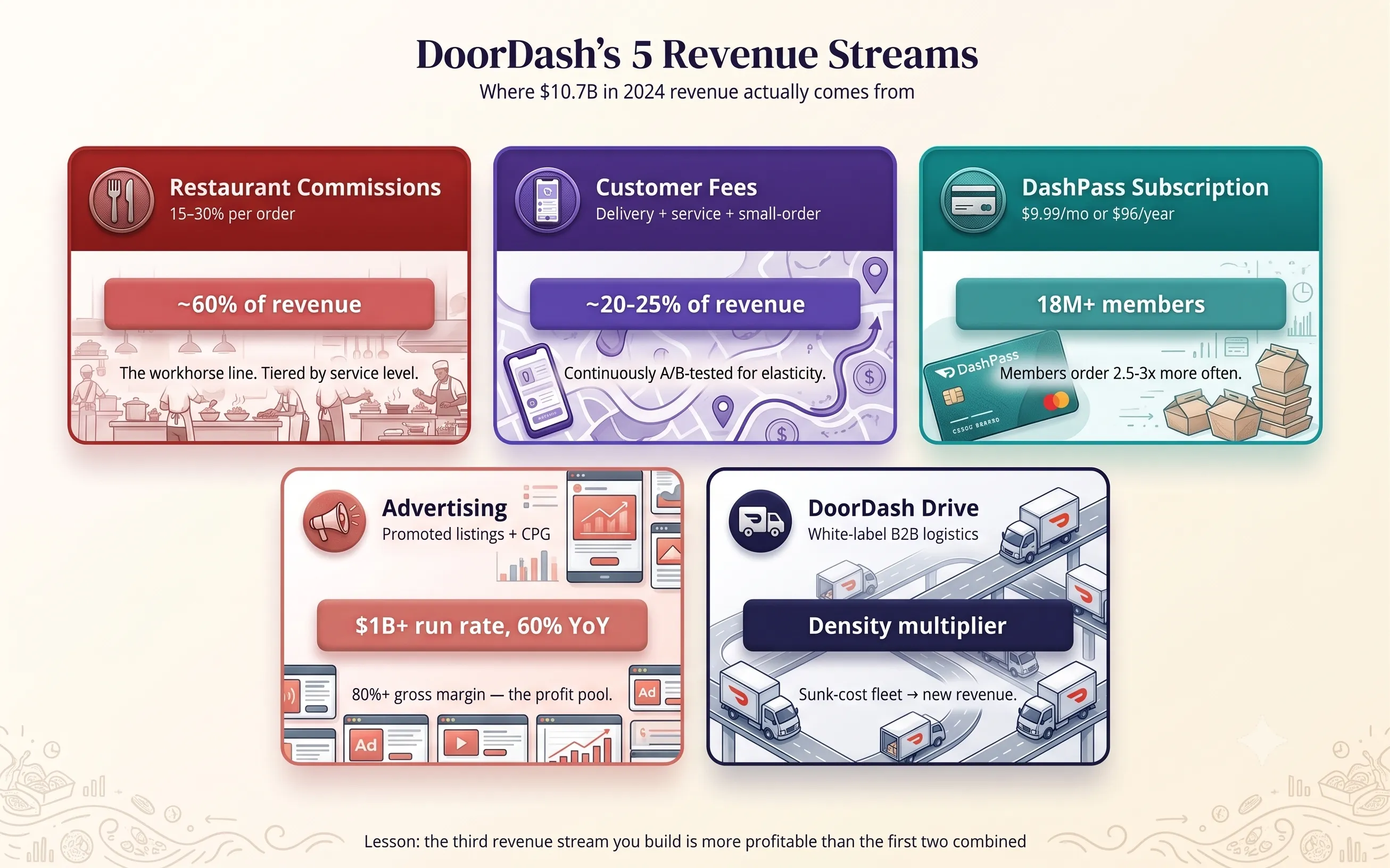
1. Restaurant Commissions (the biggest line, by far)
DoorDash charges restaurants a commission per order. According to the company's published merchant pricing page, commissions run 15–30% of the order subtotal depending on the tier of service:
- DoorDash Basic (~15%): Restaurants get listed and delivered, but pay lower marketing exposure.
- DoorDash Plus (~25%): Higher search placement, larger delivery radius.
- DoorDash Premier (~30%): Promoted listing in the app, guaranteed delivery time, full marketing services.
Restaurants choose their tier — which is itself a brilliant design decision because it converts a flat commission complaint into a self-selected price. The same restaurant that grumbles about "30% take rate" picked the 30% tier because the marketing lift justified it.
Roughly 60% of DoorDash's revenue comes from this line. It's the workhorse.
2. Customer-Side Fees: Delivery + Service + Small-Order Fees
When you order, you see three fees on the receipt:
- Delivery fee ($0.99–$5.99, variable by distance, demand, and time).
- Service fee (typically 10–15% of subtotal, capped on large orders).
- Small-order fee ($2 when subtotals are below ~$10).
These customer-side fees account for roughly 20–25% of revenue. They're also DoorDash's most-tested lever: the company runs continuous experiments on fee elasticity by market, and the math gets surprisingly granular. A 50-cent change in delivery fee in a saturated suburban market can swing weekly order volume by 4–6%.
3. DashPass Subscription Revenue
DashPass costs $9.99/month or $96/year and gives subscribers $0 delivery fees on orders over $12, plus reduced service fees, plus exclusive merchant offers. DoorDash reported over 18 million DashPass members in its Q1 2024 shareholder letter.
If you do the math — even at the discounted $96/year price — that's a recurring revenue line approaching $1.5 billion that doesn't depend on whether anyone orders this week. The strategic value is even bigger than the dollar line: DashPass members order 2.5–3x more often than non-members, which means the subscription is also DoorDash's most effective customer retention mechanism.
4. Advertising and Promoted Listings (the hidden flywheel)
This is the line that's growing fastest and that most people miss. DoorDash sells sponsored merchant placements, sponsored product listings within merchants, and CPG (consumer packaged goods) advertising where brands like PepsiCo or Procter & Gamble pay to promote specific products on grocery and convenience orders.
The advertising business was a $1B+ run-rate line at the end of 2024, growing roughly 60% year-over-year. Crucially, advertising revenue has 80%+ gross margins — it's pure software-economics inside a logistics business. This is the same flywheel Amazon discovered around 2016, and it's the single largest reason DoorDash's overall margins are expanding even as transaction volume growth slows.
For marketplace founders, this is the lesson buried in the financials: the third revenue stream you build is more profitable than the first two combined. Get to scale first; monetize the scale second.
5. DoorDash Drive (white-label logistics for businesses)
DoorDash Drive is the company's B2B logistics product. Any business — a local florist, a national pharmacy chain, a Shopify merchant — can use DoorDash's courier network to fulfill their own deliveries, paying DoorDash per delivery. The customer never sees DoorDash branding; they see the merchant's brand and a courier showing up.
This is how DoorDash turned its sunk cost (a national fleet of couriers) into a revenue source that's independent of the consumer app. It also gives the company densification — more deliveries per Dasher hour means lower cost per delivery, which loops back to improve consumer-facing economics.
DoorDash Unit Economics: Where the Money Actually Goes
This is the conversation that gets cut from most "how does DoorDash make money" articles, but it's the only one founders actually need. Let's walk through the per-order math, using disclosed averages from DoorDash's 2024 10-K and supplemented by analyst breakdowns published by Marketplace Pulse and a16z's marketplace research.
A typical $30 food order in 2024 looked roughly like this:
| Line Item | Amount | Notes |
|---|---|---|
| Customer subtotal | $30.00 | Food cost |
| Service fee (12%) | $3.60 | Goes to DoorDash |
| Delivery fee | $4.99 | Goes to DoorDash |
| Tip | $5.00 | Passes through to Dasher |
| Customer pays | $43.59 | |
| Restaurant commission (20% of subtotal) | $6.00 | Goes to DoorDash |
| Total DoorDash revenue | $14.59 | |
| Dasher pay (base + bonuses + tip) | $9.50 | Cost to DoorDash |
| Payment processing (illustrative) | $1.26 | Cost to DoorDash |
| Insurance, support, ops allocation | $2.50 | Cost to DoorDash |
| DoorDash contribution margin | ~$1.30 | ~3% of total order |
Every figure above is an illustrative model, not reported DoorDash accounting. The payment-processing line assumes a rate of roughly 2.9% of the customer total; actual processor fees vary by country, payment method, and card type, so treat it as an assumption rather than a current universal rate.
That $1.30 of contribution margin per order is — for years — what DoorDash bears was the death of the model. It is razor-thin. And it's why the unit economics improvement on each new revenue stream matters so much:
- DashPass member orders skip the customer-side fees on DoorDash's side but the member already paid $9.99 for the month before ever placing an order.
- An advertising-influenced order earns DoorDash an extra $0.50–$1.50 in ad rev with near-zero incremental cost.
- A Drive order skips the customer-acquisition cost entirely.
Once DoorDash hit roughly 30% of orders being "enhanced" by one of these three streams, the contribution margin per order doubled. That's when the company turned profitable.
How DoorDash Acquires All Three Sides of the Marketplace
A three-sided marketplace is materially harder than a two-sided one. DoorDash has played a specific game on each side.
Restaurants: DoorDash launched in 2013 with a now-famous tactic: the founders listed restaurants without permission, fulfilled orders by personally driving the deliveries, and then approached the restaurant after they'd made a few hundred dollars in incremental sales asking if they'd like to formalize the relationship. The aggressive ground-game continued for years — by 2018, DoorDash had a sales team of 200+ doing nothing but cold-walking into restaurants.
Dashers: The pitch was simple — flexible hours, sign up in a day, get paid weekly. The unit economics for Dashers are roughly $14–$25/hour gross before vehicle costs in most US markets, which is competitive with retail and food service entry-level wages. DoorDash now has more than 7 million Dashers in its network (lifetime sign-ups).
Customers: The early years were a brutal promo war (DoorDash, Uber Eats, Grubhub, Postmates all subsidizing orders below cost). Post-2020, the game shifted to retention via DashPass and selection breadth (more restaurants than the competition in any given ZIP code). DoorDash now holds 65%+ market share in US food delivery — and that share has actually expanded since 2022 even as the category matured.
DoorDash vs Uber Eats vs Grubhub: How Their Business Models Differ
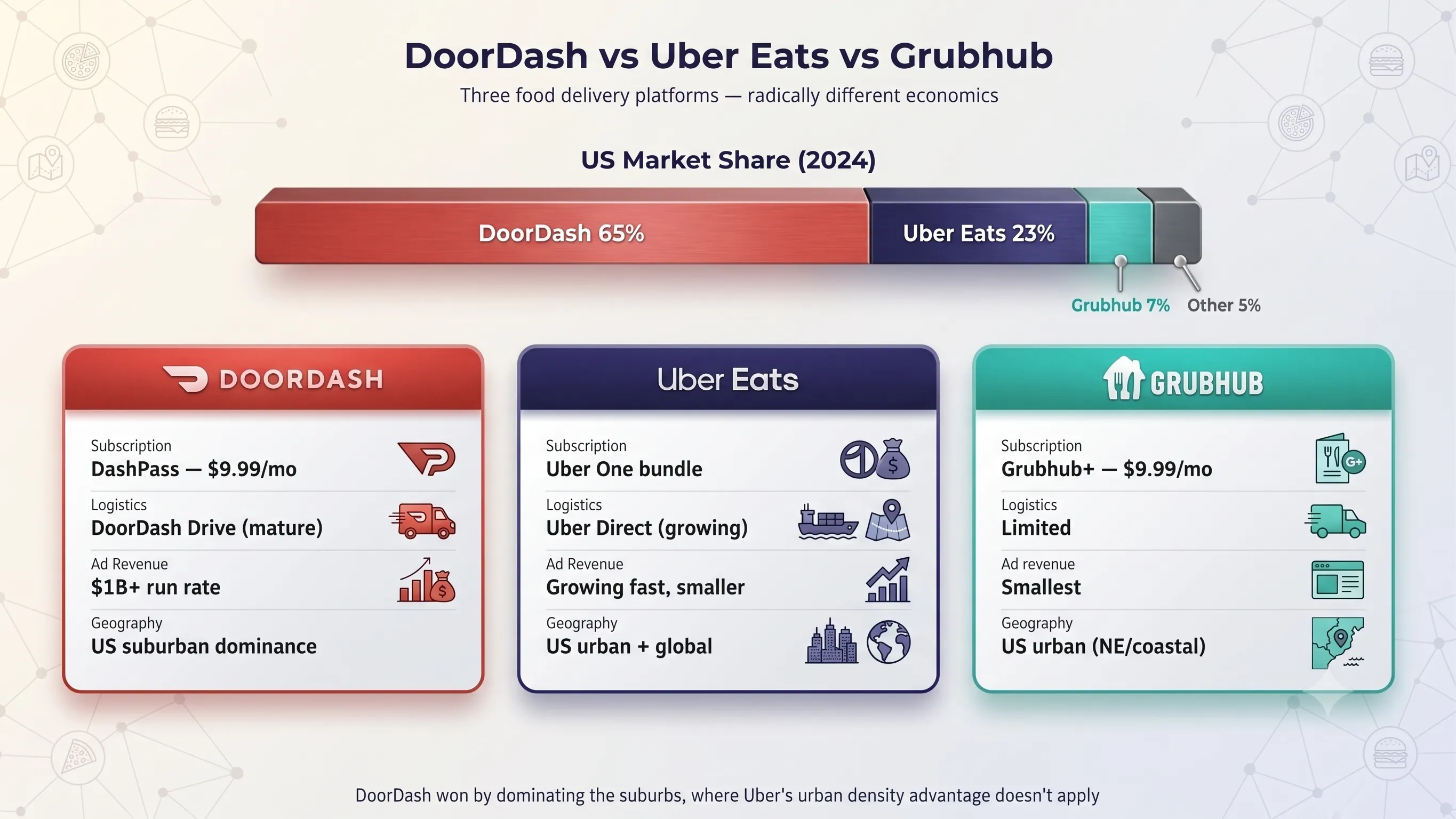
All three are food delivery marketplaces; their economics diverge in important ways.
| Dimension | DoorDash | Uber Eats | Grubhub |
|---|---|---|---|
| Restaurant commission range | 15–30% | 15–30% | 10–30% |
| Customer-side fees | Service + delivery + small order | Service + delivery + dynamic surge | Service + delivery |
| Subscription product | DashPass ($9.99/mo) | Uber One ($9.99/mo, bundled with rides) | Grubhub+ ($9.99/mo) |
| Advertising business | Largest of the three, ~$1B+ run rate | Growing fast, smaller base | Smallest |
| White-label logistics | DoorDash Drive (mature) | Uber Direct (growing) | Grubhub Direct (limited) |
| Geographic focus | US suburban dominance | US urban + global | US urban (mostly NE/coastal) |
| 2024 US market share | ~65% | ~23% | ~7% |
The key insight: DoorDash beat the competition in the suburbs, where Uber Eats's rideshare-network advantage (urban density of drivers) doesn't apply, and where Grubhub's restaurant-first heritage (it was a directory before it was a delivery service) didn't translate to a logistics product.
7 Lessons Every On-Demand Marketplace Founder Can Steal From DoorDash
If you're building a marketplace — service, on-demand, hyperlocal, or otherwise — these are the patterns worth internalizing.
1. Pick a side and self-fulfill until the flywheel starts
DoorDash's founders manually drove deliveries for the first year. Most successful on-demand marketplaces have a "fake it" phase. Don't outsource what you don't yet understand.
2. Tiered take-rate is better than flat take-rate
Letting suppliers choose their level of marketing investment converts pricing complaints into self-selection. Whether you're building a service marketplace, B2B portal, or rental aggregator, design for tiered commissions early — see our service marketplace software guide for vertical-specific patterns.
3. The third revenue stream is where the profit hides
Transactional fees are competitive and compressed. The defensible margin comes from subscription, advertising, or B2B leverage of your core network. Plan for it from Year 2.
4. Densify before you geographically expand
DoorDash won by dominating one city at a time. The marketplace flywheel only spins when local liquidity is high enough that customer-to-order conversion is reliable. Spread thin and you bleed CX costs without ever hitting the density that makes the unit economics work.
5. Subscriptions are retention, not revenue
DashPass's $9.99/month isn't the point. The point is that members order 2.5x more often. If you're running a frequent-purchase marketplace, design a subscription product within your first 18 months.
6. The advertising business is hidden behind your search results
If your marketplace has a search page, you have an ad business in waiting. Promoted listings, featured placement, and category-sponsored ads all flow from controlling discovery. Don't launch with them — but architect your search to enable them by Month 18.
7. Don't pick a fight with the category leader; pick a niche
DoorDash didn't beat Grubhub by being a better Grubhub. It beat Grubhub by owning a different geography and operating model (suburban + logistics-first vs urban + directory-first). If you're entering a competitive marketplace category in 2026, find the geographic, vertical, or operational seam — don't try to win on features.
Want to Build a DoorDash-Style Marketplace? Here's Your Path
The unflattering truth: building DoorDash from scratch in 2026 is a $200M+ proposition before you get to material revenue. The capital, the operations team, the city-by-city ground game, the regulatory work — it's a megacorp build, not a startup build.
But building a vertical DoorDash — an on-demand service marketplace for one specific use case, in one specific region, with the DoorDash playbook applied — is absolutely possible at a fraction of that cost. The two paths:
Path A: Use a marketplace platform. Spin up the core marketplace mechanics — listings, dispatch, payments, ratings, messaging — on a purpose-built platform like Nipige's restaurant delivery template, then layer your vertical logic and supply playbook on top. Time to functional MVP: 6–12 weeks. Cost: $899–$5,499+/month all-in.
Path B: Custom build with a logistics-aware tech partner. Only makes sense once you have validated demand in a specific vertical and you've outgrown the platform's customization ceiling. Time: 9–18 months. Cost: $400K–$1.5M Year 1.
For 95% of "DoorDash for X" founders, Path A is the right call until you've proven the unit economics in your specific vertical. After that, you have the leverage to decide whether to keep going on the platform (most do) or migrate to a custom build (few need to).
Frequently Asked Questions
Is DoorDash actually profitable?
Yes — DoorDash reported its first full-year GAAP net profit in 2024 ($123 million on $10.7B in revenue), after a decade of operating losses. The path to profitability came from three things: tiered commission structures expanding average take rate, DashPass subscription scale, and advertising revenue. The food-delivery transactional business alone is barely profitable; the layered revenue streams are what tipped it.
What percentage does DoorDash take from restaurants?
15–30%, depending on the tier of service the restaurant chooses. Restaurants on the basic tier pay ~15%; those on premier pay up to ~30%, but receive significantly more marketing exposure in the app.
How does DashPass make money for DoorDash?
DashPass is roughly $1.5B+ in annual subscription revenue at scale (18M+ members × ~$96/year on average), but the larger value is that members order 2.5–3x more often than non-members, which dramatically improves the per-customer lifetime value.
Can a startup compete with DoorDash?
Not head-on. A startup absolutely can win in verticals DoorDash deprioritizes — specialty pharmacy delivery, B2B parts logistics, niche restaurant categories, hyperlocal grocery in markets where DoorDash isn't dominant. The pattern is always: vertical depth or geographic specificity that DoorDash's generalist product can't match.
What's the difference between DoorDash and DoorDash Drive?
DoorDash (the consumer app) is the marketplace where customers order from listed restaurants. DoorDash Drive is the white-label logistics product, where any business uses DoorDash's courier network to fulfill their own deliveries — the customer never sees DoorDash branding.
The Next Step
Studying how DoorDash makes money is the easy part. Applying the lessons — tiered commissions, densification before expansion, subscription as retention, advertising as the third profit pool — to your own marketplace requires a platform that's flexible enough to support that evolution.
That's what we built Nipige for. It's a purpose-built marketplace platform for founders going after on-demand, service, and hyperlocal verticals where the DoorDash playbook applies but the unit economics need to be tuned to a specific category. Vendor onboarding, multi-party payments, dispatch logic, tiered commissions, and the foundations of an ad/sponsored business are all there from Day 1.
See how Nipige handles on-demand marketplace logic → A 20-minute walkthrough against your specific vertical and a working demo of the dispatch + payments stack.
The Nipige team builds and operates production marketplace infrastructure - vendor onboarding, real-time dispatch, payments, and native apps - drawing on 13+ years of enterprise billing and monetization engineering at Trigital Technologies.