Marketplace Business Models Explained: How Marketplaces Actually Make Money (2026)
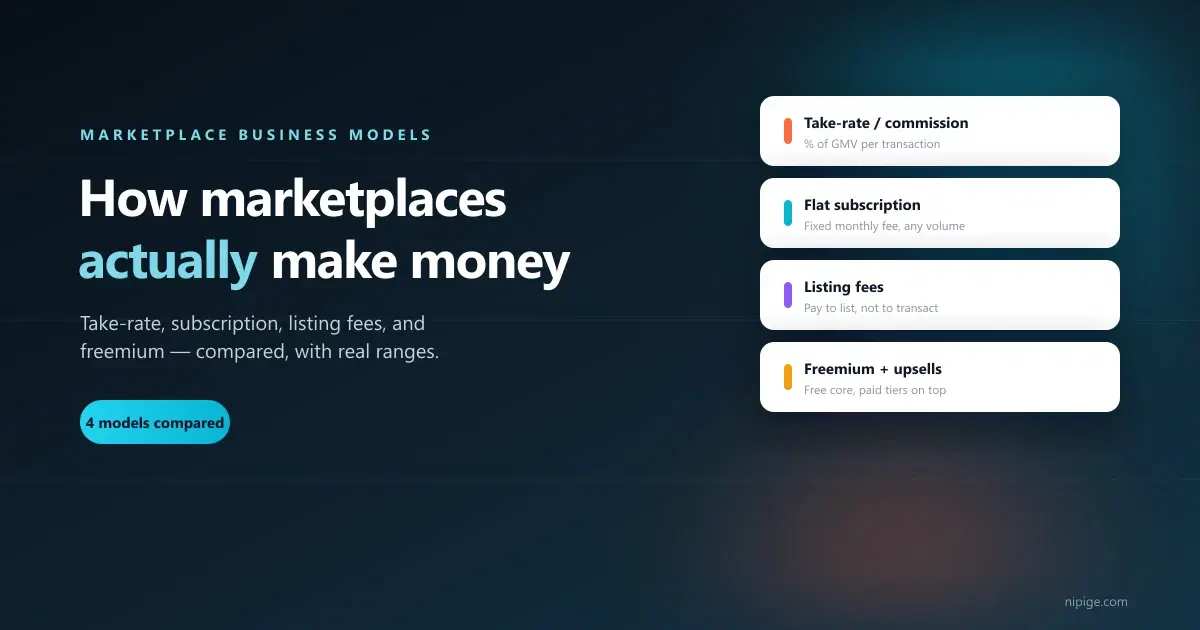
The four main marketplace business models are commission (take-rate), subscription, listing fees, and freemium with upsells. Most marketplaces start with a commission on each transaction, then layer on subscriptions or ads as they grow. Your choice sets your pricing, your margins, and how you recruit both sides of the marketplace.
Every marketplace's product decisions trace back to one number: how it makes money. A marketplace that takes 25% per transaction builds differently than one charging a flat monthly fee — different growth incentives, different vendor relationships, different unit economics at scale. Understanding the four core marketplace business models is the fastest way to understand why any given marketplace looks the way it does.
This guide breaks down each model, the ranges that actually hold up in practice by vertical, and how to think about which one fits your marketplace.
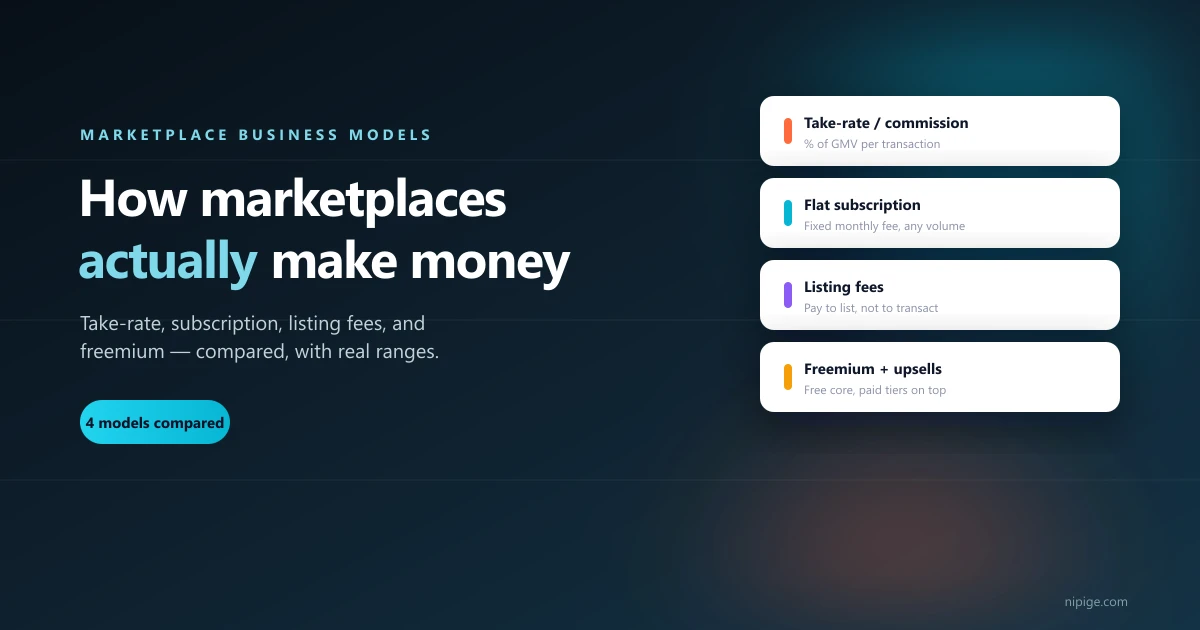
The 4 Marketplace Business Models
1. Commission / Take-Rate
The operator takes a percentage of every transaction. This is the model most people picture when they hear "marketplace" — it's how DoorDash (15–30% from restaurants), Airbnb (roughly 14–19% combined from hosts and guests), and most on-demand and service marketplaces earn.
The appeal: revenue scales directly with marketplace activity, and the operator's incentives align with vendor success — you only earn when they do.
The catch: take-rate scales with GMV, but it caps founder margin at high volume. As order volume grows, so does the platform's total revenue — but the percentage stays fixed, which means the operator's margin per order doesn't improve with scale the way a subscription model's does.
2. Flat Subscription
Vendors or operators pay a fixed monthly fee regardless of transaction volume. This is Nipige's own model: $0 platform transaction fees across every tier, with the fee being the software subscription itself.
The appeal: a flat-subscription model keeps 100% of GMV for the operator instead of taking a cut — which favors high-volume, thin-margin verticals like restaurant delivery, where a percentage-based take rate would compress margin exactly when volume is highest.
The catch: subscription revenue doesn't automatically grow with marketplace success the way take-rate does — pricing tiers need to be structured around usage (vendor count, order volume) to capture value as operators scale.
3. Listing Fees
Vendors pay to list, not to transact. Common in classifieds-style and some real estate and B2B marketplaces, where transaction frequency per vendor is low but the value of a single listing is high.
The appeal: revenue doesn't depend on the operator successfully facilitating every transaction — useful when transactions often happen partially off-platform (a common pattern in real estate and B2B).
The catch: it decouples operator revenue from transaction value, so a listing fee that's too low relative to deal size leaves money on the table, while one that's too high discourages vendors from listing at all.
4. Freemium + Upsells
A free core product with paid tiers layered on top — extra visibility, advanced analytics, premium placement, or additional features. Common in gig-work and services platforms where getting vendors in the door matters more than monetizing day one.
The appeal: the lowest possible barrier to vendor adoption, which matters most in the cold-start phase of a new marketplace.
The catch: monetization depends entirely on upsell conversion, which is a harder lever to pull reliably than a built-in take rate or subscription fee.
Which Model Fits Which Vertical
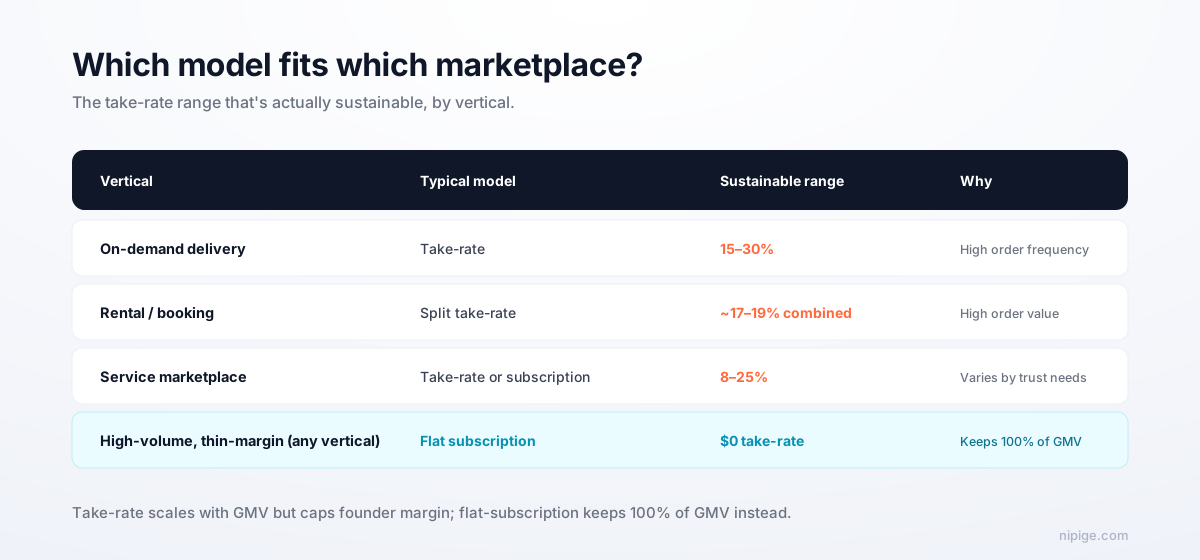
| Vertical | Typical model | Sustainable range | Why |
|---|---|---|---|
| On-demand delivery | Take-rate | 15–30% | High order frequency funds the model |
| Rental / booking | Split take-rate | ~17–19% combined | High order value supports the cut |
| Service marketplace | Take-rate or subscription | 8–25% | Varies by trust and verification needs |
| High-volume, thin-margin (any vertical) | Flat subscription | $0 take-rate | Keeps 100% of GMV at scale |
For the deep-dive on any one vertical: see how DoorDash's five revenue streams combine commission, fees, subscription, and advertising; our guide on building a multi-vendor marketplace for the primitives every model needs regardless of vertical; and our service marketplace software buyer's guide for the take-rate range specific to services.
How much a platform earns depends on how hands-on it is. See managed marketplace vs listing marketplace for the two ends of that scale.
Why Most Mature Marketplaces Combine Models
DoorDash is the clearest example: restaurant commissions are the largest line, but customer delivery fees, the DashPass subscription, and advertising revenue all sit alongside it — four separate levers instead of one. Combining models diversifies revenue and reduces how much any single number (like a commission rate) has to carry the whole business.
For a new marketplace, the practical version of this is usually simpler: pick one primary model that fits your vertical's transaction economics, and consider a secondary line (a subscription tier for power vendors, a listing-fee option for high-value verticals) once the primary model is proven.
How to Choose Your Marketplace's Business Model
Look at transaction frequency and order value. High-frequency, low-margin categories (food delivery, gig services) tend toward take-rate or flat subscription, because a listing fee wouldn't generate enough revenue per vendor. Low-frequency, high-value categories (real estate, B2B) can support listing fees because a single deal justifies the cost.
Look at what a take-rate does to your vendors at scale. If your vertical is high-volume and thin-margin, a percentage-based take rate compresses vendor economics exactly as they grow — which is why flat-subscription models exist, and why they're the right fit for exactly that shape of business.
Model your own unit economics before picking, not after. The founder-margin math looks completely different at 100 orders/month versus 100,000 — pressure-test your model at the volume you actually expect to reach, not just at launch.
Once you've picked a model, the next decision is how you build the platform that runs it. See build vs buy a marketplace to work through that call.
Frequently Asked Questions
What are the main marketplace business models?
Four common models: commission/take-rate (a % of each transaction), flat subscription (a fixed monthly fee regardless of volume), listing fees (pay to list, not to transact), and freemium-plus-upsells (a free core product with paid tiers on top). Most marketplaces use one as primary and a second as a secondary revenue line.
What take rate should a marketplace charge?
It depends heavily on vertical: 15–30% for on-demand delivery, roughly 17–19% combined for rental/booking marketplaces, and 8–25% for service marketplaces. Below the low end, support and trust-and-safety costs erode margin; above the high end, vendors churn off-platform.
Why would a marketplace use a flat subscription instead of taking a commission?
A flat-subscription model keeps 100% of transaction value for the operator instead of taking a cut. This favors high-volume, thin-margin verticals — restaurant delivery being the clearest example — where a percentage-based take rate compresses margin exactly when volume is highest.
Can a marketplace combine more than one business model?
Yes, and most mature marketplaces do. DoorDash combines restaurant commissions with customer fees, a subscription product (DashPass), and advertising revenue. Combining models diversifies revenue and reduces dependence on any single lever.
Is take-rate or subscription better for a new marketplace?
Take-rate aligns your revenue with vendor success from day one, which is attractive pre-scale, but it caps your margin as volume grows. Subscription gives predictable revenue and full margin retention but requires vendors to pay regardless of their own results. The right choice depends on your vertical's transaction volume and margin per order.
The Next Step
Nipige runs on the flat-subscription model by design — $0 platform transaction fees across every tier, so operators in high-volume verticals like restaurant delivery, real estate, and service marketplaces keep 100% of every transaction instead of losing a percentage to the platform.
See the full pricing breakdown → Compare tiers, or book a 20-minute walkthrough → to model your own unit economics against your actual transaction volume.
The Nipige team builds and operates production marketplace infrastructure - vendor onboarding, real-time dispatch, payments, and native apps - drawing on 13+ years of enterprise billing and monetization engineering at Trigital Technologies.