Build vs Buy a Marketplace (2026): How to Decide
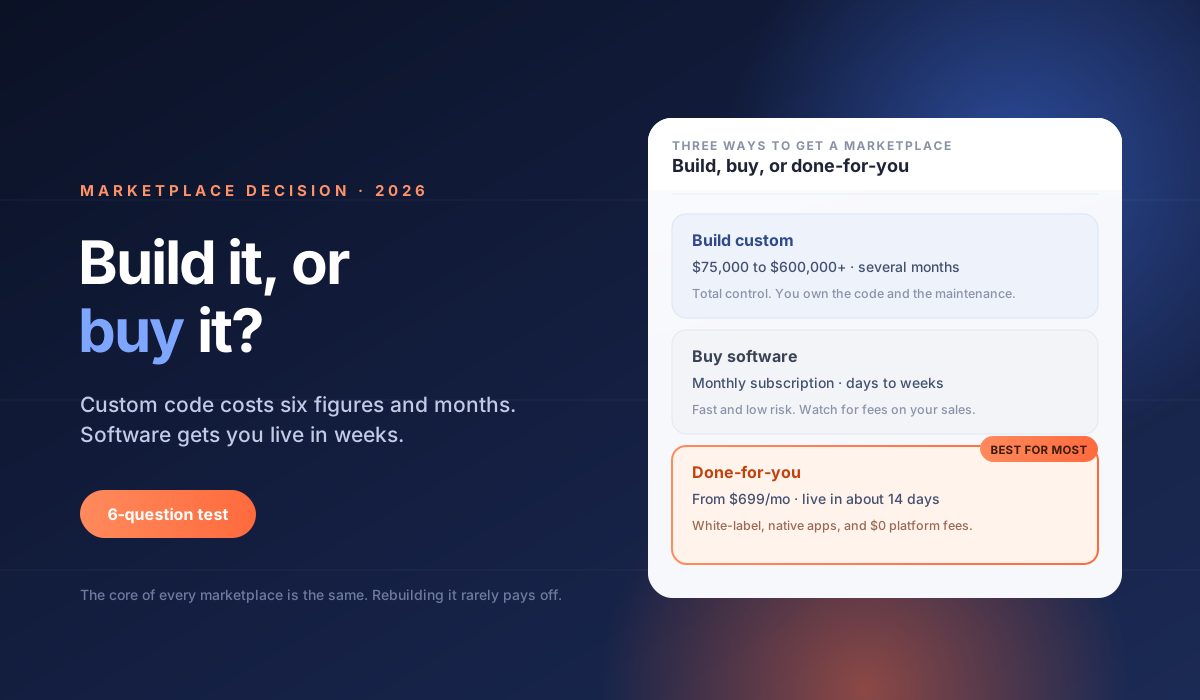
A custom marketplace built from scratch runs roughly $75,000 to $600,000 and takes months before it is live. Marketplace software gets you there in weeks for a monthly fee. So which way should you go? It comes down to one thing, and it is not your budget: is the marketplace itself what makes you different, or do you just need a working platform fast so you can start signing up vendors? Here are the real numbers, a quick test to run your idea through, and the option a lot of guides leave out.
Should you build or buy a marketplace?
Buy it, unless you have a real reason not to. For a standard multi-vendor marketplace where speed matters, buying is the safer bet. Building only makes sense when some unusual workflow is genuinely your edge and you have the money and the engineers to keep it running for years. Here is why: under the hood, every marketplace does the same handful of jobs. Listings, search, payments, vendor management, an admin panel. That part is basically a solved problem. What decides whether you make it is getting to market and filling both sides, not rebuilding plumbing that already works everywhere else.
What does it cost to build a marketplace from scratch?
A lean custom build starts around $75,000. A full, production-grade marketplace with native apps and proper trust-and-safety tooling runs $150,000 to $600,000 or more, spread over several months. And the bill does not stop at launch. Set aside another 15 to 20 percent of the build cost every year just to keep it patched, secure, and up to date, on top of the team you now have to keep on payroll. You get total control for that money. You also own every problem that comes with it.
What does it cost to buy marketplace software?
Buying swaps that big upfront number for a monthly subscription and cuts the timeline to weeks. The thing to check is the fine print on fees. Some platforms charge you a subscription and then take a percentage of every sale on top, a cut of your revenue that sits above what Stripe or PayPal already charge. It looks harmless at $2,000 a month in sales. At $80,000 a month it is a real line on your P&L, and it gets bigger every time you grow. So when you line platforms up, work out what each one actually costs at the volume you are aiming for, not the number on the pricing page.
Build vs buy: the honest trade-offs
| Dimension | Build custom | Buy SaaS | Done-for-you platform |
|---|---|---|---|
| Upfront cost | $75k to $600k+ | low monthly | low monthly |
| Time to launch | months | days to weeks | about 2 weeks |
| Control | total | limited to the platform | high (white-label) |
| Maintenance | you own it | the vendor | the vendor |
| Native mobile apps | you build them | often an add-on | often included |
| Fees on your sales | none | sometimes a commission | depends on the vendor |
| Risk | highest | low | low |
A quick build-vs-buy test
Run your idea through these six questions. The more your answers lean toward standard, fast, and no, the more obvious buying becomes.
- Is a plain multi-vendor marketplace enough, or is your workflow genuinely one of a kind? If it is standard, buy.
- How soon do you need to be live? Weeks points to buying. Only a long runway makes building reasonable.
- Do you have engineers, and do you actually want to keep paying them to maintain this thing? No team means buy.
- Would a platform skimming a percentage of your sales hurt as you scale? If yes, only look at flat-fee or zero-fee options.
- Do you need native iOS and Android apps on day one? Building those alone is a project in itself.
- Will you need to own or heavily change the code down the line? If so, weigh a custom build, or a platform that gives you source-code access.
There is a third option: done-for-you
Somewhere between wrestling with SaaS yourself and commissioning a six-figure build sits a done-for-you, white-label platform. Someone else sets up a production marketplace for you, you put your own brand on it, and you launch in weeks. You get the price and speed of buying, but it feels closer to something you own. For a founder who wants a real, branded marketplace fast, without hiring developers or signing off on a $200,000 project, this is usually the right call, especially when the platform does not take a slice of your sales.
Once you have decided to buy rather than build, a founder's checklist for choosing a platform walks through what actually separates a good platform from a bad one.
Where Nipige fits
Nipige is the done-for-you route. It is a no-code, white-label marketplace builder: you get a customer app, a vendor app, an admin console, and native iOS and Android apps, set up for your vertical and live in about 14 days. Pricing is a flat monthly subscription, and it charges a $0 platform transaction fee, so no platform commission is deducted from your sales and the platform never takes a bigger bite as you grow.
Put another way, the six-figure custom build from earlier turns into a predictable monthly cost, with no code to write. Plans are on the pricing page, the Sharetribe alternative comparison shows how it stacks up, and if you want the full custom-build math, read what it costs to build a marketplace. When you are ready, book a live demo.
Frequently Asked Questions
Is it cheaper to build or buy a marketplace?
Buying is far cheaper to start. A custom build runs roughly $75,000 to $600,000 plus ongoing maintenance, while marketplace software is a monthly subscription. Building only pays off when a unique workflow is your competitive edge and you have the capital and team to sustain it.
How long does it take to build a marketplace vs buy one?
A custom marketplace takes several months to a first launch. Buying marketplace software takes days to weeks, and a done-for-you white-label platform can go live in about two weeks, because the apps are already built and you are configuring them rather than coding from scratch.
When should I build a marketplace from scratch?
Build when the marketplace workflow itself is your competitive advantage, when no existing platform can support your model, and when you have the capital and the engineering team to fund the build and its ongoing maintenance. For a standard multi-vendor model, buying is lower risk.
What are the hidden costs of marketplace software?
The main hidden cost is a commission or transaction fee that some platforms take on every sale, on top of the subscription and your payment processor's rate. That percentage grows with your sales, so read the total cost of ownership and favour platforms with flat or zero platform fees.
Can I customise a marketplace platform I buy?
Yes, to a point. No-code platforms let you configure branding, categories, and workflows without a developer, and some offer deeper customisation or source-code access on higher plans. If you need to change everything at the code level, that is the case for a custom build.
The Nipige team builds and operates production marketplace infrastructure - vendor onboarding, real-time dispatch, payments, and native apps - drawing on 13+ years of enterprise billing and monetization engineering at Trigital Technologies.