No-Code Marketplace Builder: B2B vs B2C
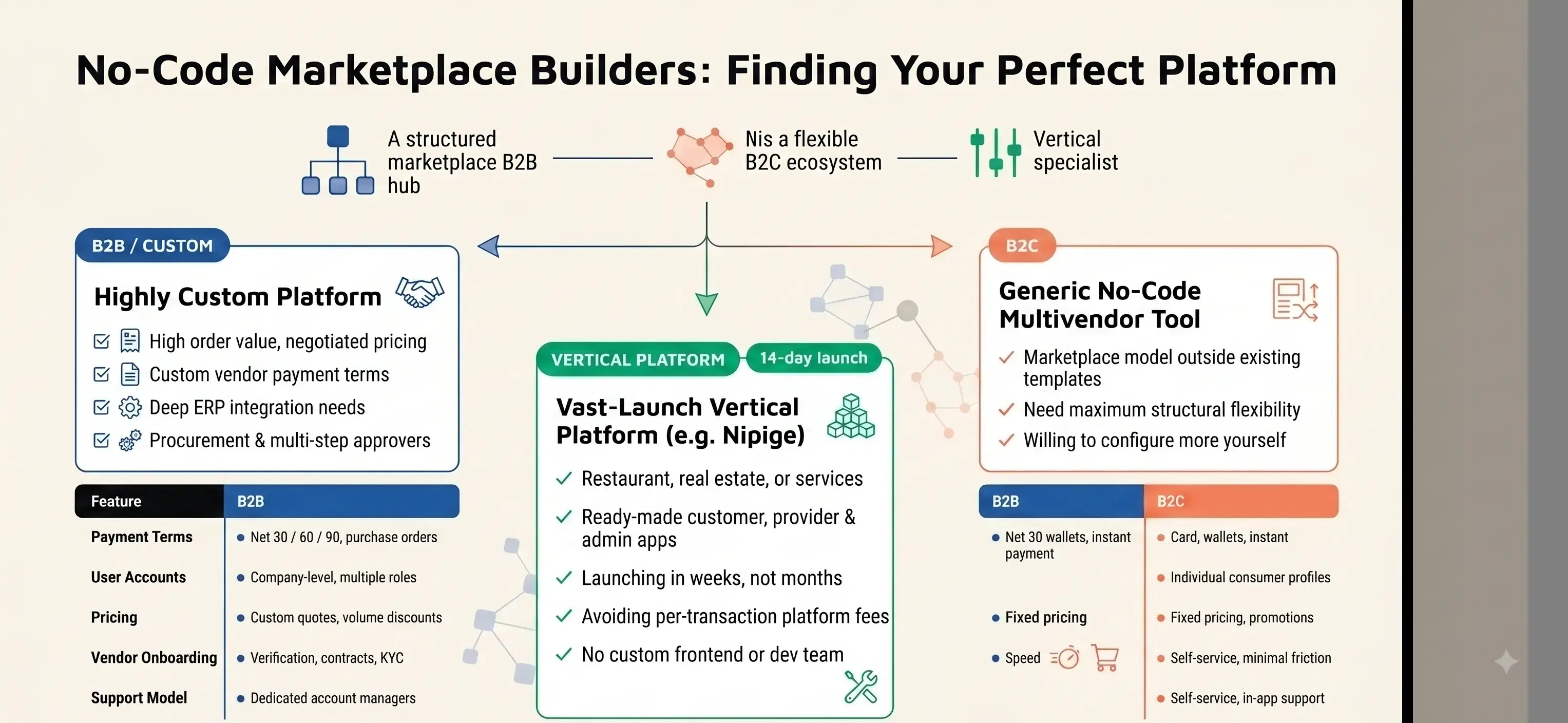
No-code marketplace builders have made it possible to launch multi-vendor platforms without writing application code. But B2B and B2C marketplaces have fundamentally different requirements — from payment structures and vendor management to compliance and user experience. This guide breaks down how to choose the right no-code marketplace builder for your business model, and where a vertical-ready platform like Nipige fits in.
Understanding B2B vs B2C marketplace needs
Choosing the right multi-vendor platform starts with knowing which side of the B2B/B2C line your marketplace sits on — the requirements diverge quickly.
B2B marketplace requirements
B2B marketplaces connect businesses with other businesses, typically involving higher transaction values, longer sales cycles, and more complex workflows. Key requirements include:
- Bulk ordering and tiered pricing structures
- Custom invoicing and net payment terms (30, 60, 90 days)
- Advanced vendor management with approval workflows
- RFQ (Request for Quote) functionality
- Role-based access control for multiple users per account
- Integration with ERP and accounting systems
- White-label options for enterprise customization
B2B transactions tend to run at significantly higher average order values than B2C, which makes payment reliability and vendor verification critical from day one.
B2C marketplace requirements
B2C marketplace platforms serve individual consumers and prioritize speed, simplicity, and conversion. Essential features include:
- Streamlined checkout (one-click purchasing, guest checkout)
- Consumer payment methods (credit cards, PayPal, Apple Pay, Google Pay)
- Review and rating systems
- Real-time inventory or availability sync across vendors
- Mobile-first design and native apps
- Dispatch, booking, or scheduling logic, depending on the category
B2C marketplaces depend on transaction volume, so time-to-launch and platform fees have an outsized effect on margins — see how this plays out in restaurant, real estate & property, and services marketplaces.
Key differences in platform architecture
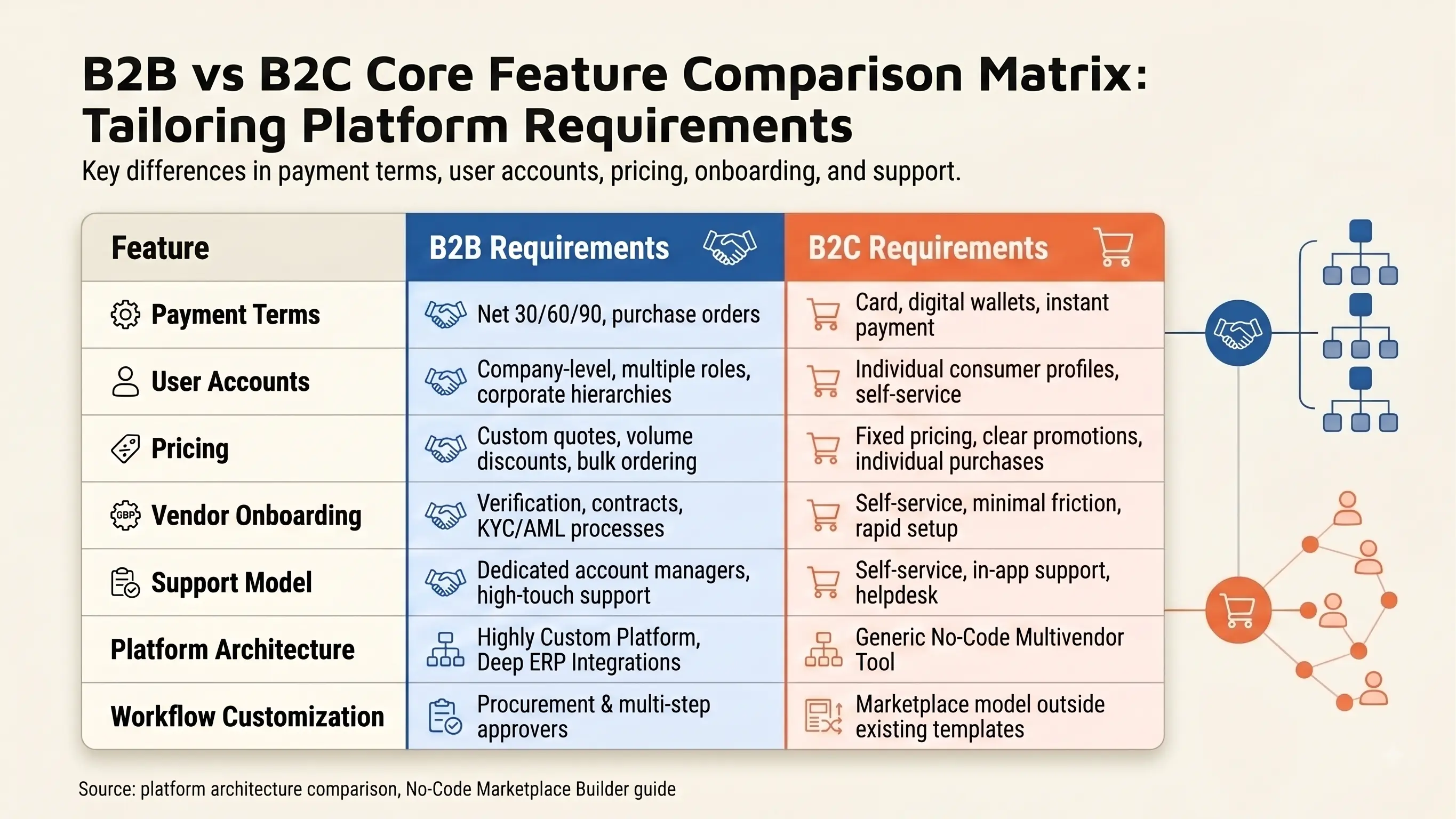
| Feature | B2B | B2C |
|---|---|---|
| Payment Terms | Net 30/60/90, purchase orders | Card, wallets, instant payment |
| User Accounts | Company-level, multiple roles | Individual consumer profiles |
| Pricing | Custom quotes, volume discounts | Fixed pricing, promotions |
| Vendor Onboarding | Verification, contracts, KYC | Self-service, minimal friction |
| Support Model | Account managers | Self-service, in-app support |
Where no-code builders fit — and where Nipige is different
Most no-code marketplace builders fall into two camps:
General-purpose builders (e.g., Shopify Plus, Webflow) — powerful and flexible, but marketplace functionality (multi-vendor payouts, provider apps, dispatch, booking) has to be bolted on through apps, plugins, or custom development. This works, but it adds setup time and ongoing plugin costs.
Generic multi-vendor platforms (e.g., Sharetribe, Dokan) — built for marketplaces in general, with flexible but unopinionated structures that still require configuration work to fit a specific industry. If you're specifically weighing this category, see our Sharetribe alternatives comparison and Mirakl alternative guide.
Nipige takes a third approach: it ships as pre-built vertical solutions — restaurant, real estate & property, and services — each already including customer, provider, and admin apps. Instead of assembling a marketplace from generic building blocks, you configure branding, pricing rules, service zones, and payments (Stripe or PayPal) on top of a working platform. Nipige is built for teams that want a marketplace live in about 14 days, without a custom frontend team, and without paying a percentage of every transaction — Nipige charges $0 platform transaction fees.
This makes Nipige a strong fit specifically for B2C and hybrid marketplaces in its three verticals, where speed to launch and predictable costs matter more than deep custom workflow logic. For complex B2B requirements — multi-level approval chains, ERP integrations, custom net-terms invoicing — a more configurable or custom-built platform may still be necessary.
Critical compliance and security considerations
Payment processing
- B2B needs to support purchase-order style workflows and reconciliation; payment security compliance is critical for higher-value transactions.
- B2C needs consumer-friendly payment methods and straightforward, PCI-compliant checkout. Nipige integrates Stripe and PayPal directly into its vertical solutions.
Vendor management
B2B typically requires thorough verification and contract management. B2C can generally use simplified, self-service onboarding — which is the model Nipige's provider apps are built around.
Decision framework: choosing your platform
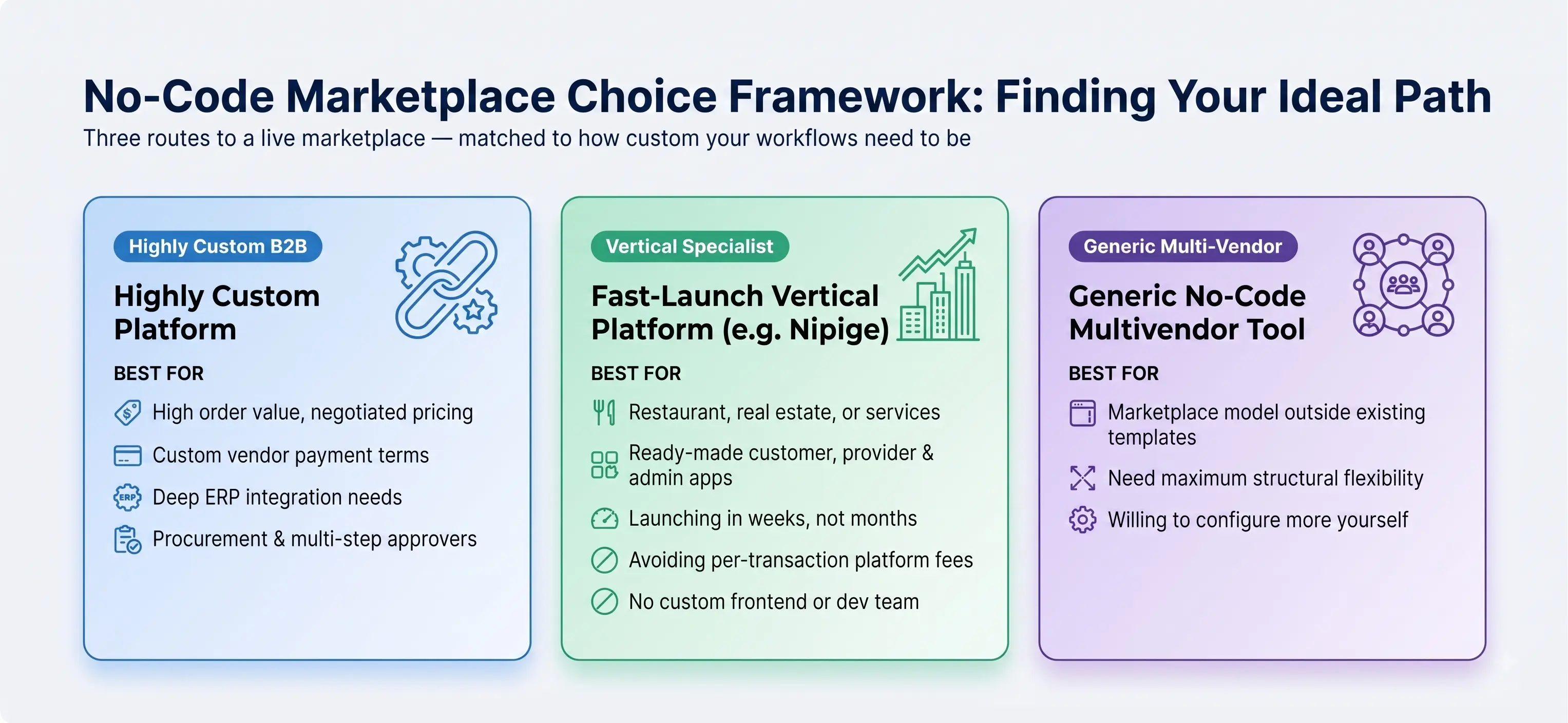
Choose a B2B-focused / highly custom platform if:
- Average order value is high and involves negotiated pricing
- Vendors require custom payment terms
- You need deep ERP integration
- Buyers include procurement teams and multi-step approvers
Choose a fast-launch vertical platform like Nipige if:
- You're building in restaurant, real estate/property, or services
- You want customer, provider, and admin apps ready out of the box
- Time-to-launch (weeks, not months) matters
- You want to avoid per-transaction platform fees
- You don't want to manage a custom frontend or dev team
Choose a generic no-code multi-vendor tool (Sharetribe, Dokan, etc.) if:
- Your marketplace model doesn't fit an existing vertical template
- You need maximum structural flexibility and are willing to configure more yourself
→ See how Nipige's vertical solutions work
Frequently asked questions
Can I start with B2C and add B2B later? It's possible, but architecture decisions around payments, user roles, and pricing logic are easier to set up correctly from the start than to retrofit. If you expect to need B2B features eventually, plan for them early.
What's the most cost-effective no-code marketplace builder for launching quickly? For the restaurant, real estate, and services verticals specifically, Nipige is built to go live in about 14 days with $0 platform transaction fees, since the customer, provider, and admin apps are already built for those categories. Generic multi-vendor builders can be cost-effective too, but typically need more configuration time before launch.
Do I need separate platforms for B2B and B2C? Not necessarily, but it depends on how different the workflows are. A single platform with unified vendor management can reduce operational overhead if your B2B and B2C needs aren't too far apart.
How long does vendor (provider) onboarding take? This varies by platform and how much verification is required. Simplified, self-service onboarding, the model used in B2C-style marketplaces, is typically much faster than B2B onboarding, which often involves KYC and contract steps.
What is a no-code marketplace builder? A no-code marketplace builder is a platform that lets you launch a multi-vendor marketplace, with customer, vendor, and admin experiences, by configuring settings instead of writing application code.
The Nipige team builds and operates production marketplace infrastructure - vendor onboarding, real-time dispatch, payments, and native apps - drawing on 13+ years of enterprise billing and monetization engineering at Trigital Technologies.