How Does Zillow Make Money? Business Model, Revenue Streams & Premier Agent Explained (2026)
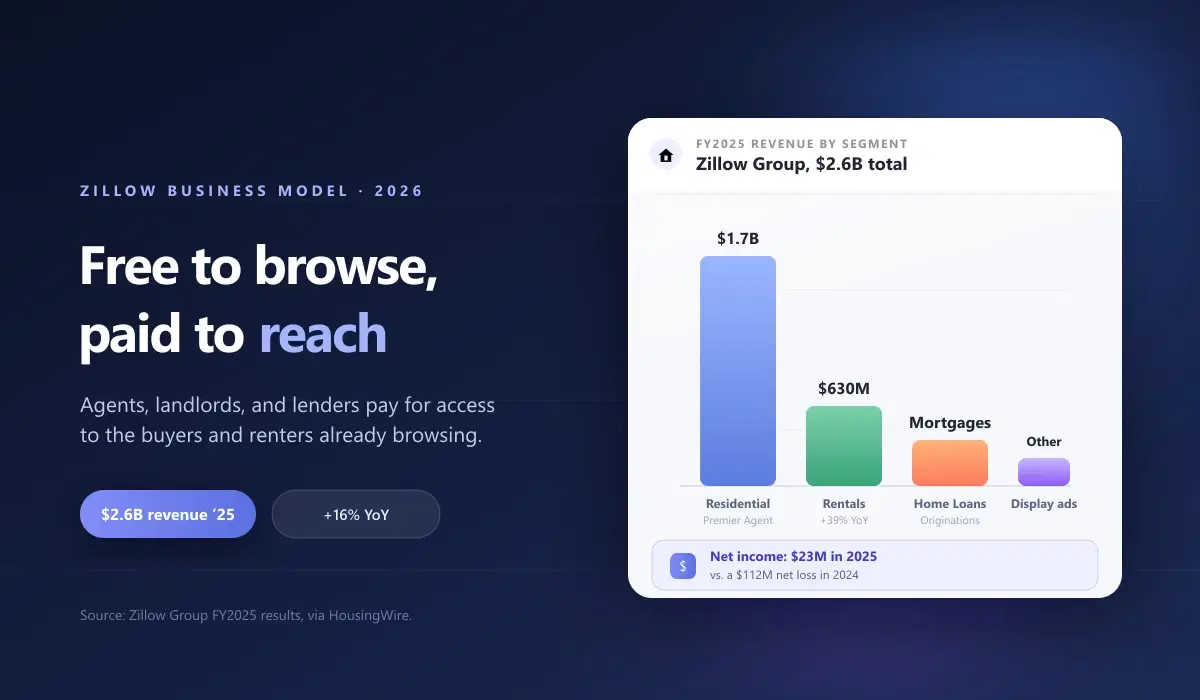
Zillow makes most of its money from advertising, not from home sales. Its largest source is Premier Agent, where real estate agents pay for leads, followed by rentals advertising and its mortgage business. Browsing listings stays free for consumers, so the marketplace monetizes the professionals who need those buyers and sellers.
Zillow doesn't take a cut of your home sale. It doesn't charge you to browse listings, save searches, or tour a house. And yet Zillow Group reported $2.6 billion in revenue for 2025, up 16% from the year before. If you've ever wondered how does Zillow make money when the product feels free, the answer is that Zillow isn't selling to home shoppers at all — it's selling access to them.
This guide breaks down Zillow's four revenue segments, how the Premier Agent advertising model actually works, why Rentals is now Zillow's fastest-growing business, and what marketplace founders can take from a model that monetizes attention instead of transactions.
The Zillow Business Model in One Sentence
Zillow is a real estate advertising and lead-generation marketplace: home and rental listings are free for consumers to browse, and Zillow earns money by selling real estate agents, landlords, and lenders access to the audience browsing that inventory — through Premier Agent advertising, rental listing tools, and mortgage origination.
That's the whole model. Everything below is detail.
Zillow's 4 Revenue Segments, Explained
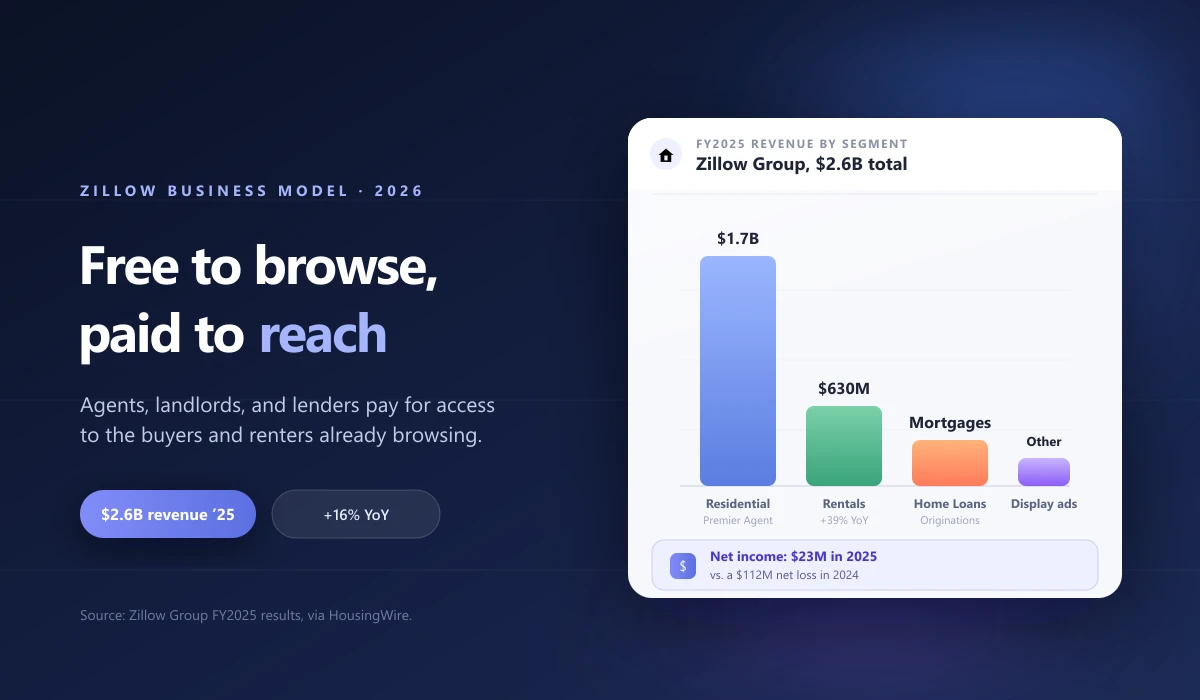
Zillow reports its revenue in four segments: Residential, Rentals, Mortgages, and Other. For full-year 2025, total revenue was $2.6 billion, up from roughly $2.24 billion in 2024, according to HousingWire's coverage of Zillow's 2025 results.
1. Residential (includes Premier Agent) — the largest segment
Residential revenue reached $1.7 billion in 2025, up 7% year over year. This is where Premier Agent lives, alongside newer products like Zillow Preferred (formerly Zillow Flex) and Zillow Showcase. Premier Agent lets agents buy advertising placement in specific ZIP codes, appearing as the featured local agent on listings and receiving buyer and seller leads generated by Zillow's traffic. Agents pay for visibility and leads, not for the listings themselves — the listings stay free.
2. Rentals — the fastest-growing segment
Rentals revenue grew 39% year over year to $630 million in 2025. Zillow's share of online rental listings grew from 54% to 63% over the same period. Landlords and property managers pay to list vacancies and use premium tools like tenant screening, applications, and rent collection — the same "pay for access and tools around free listings" pattern as Premier Agent, applied to the rental side of the market.
3. Mortgages — Zillow Home Loans
Mortgage revenue comes primarily from loan originations and the sale of those mortgages on the secondary market through Zillow Home Loans. This segment connects directly to the Residential funnel: a buyer who finds a home and an agent through Zillow can also get pre-approved and financed through Zillow, giving the company a second monetizable touchpoint in the same transaction.
4. Other — display advertising
The smallest segment, made up primarily of display advertising sold against Zillow's traffic — brand partnerships and ads targeting people actively in the moving or homeownership journey, beyond the agent- and landlord-specific products in the other three segments.
How Premier Agent Actually Works
Premier Agent is worth understanding in more detail because it's the segment most people mean when they ask how Zillow makes money.
An agent buys advertising rights to a ZIP code (or several). When a consumer views a listing in that ZIP code, the Premier Agent's profile appears alongside it as a local expert, whether or not that agent has any connection to the specific listing. Contact requests and leads generated on that listing get routed to the Premier Agent, who then works the lead into a client relationship.
This is a pay-for-attention model, not a pay-for-transaction model. The agent pays Zillow whether or not the lead converts into a closed sale — which is a meaningfully different economic bet than a marketplace that only earns a commission after a transaction actually closes.
Is Zillow Profitable?
Zillow Group reported $23 million in net income for full-year 2025, a real turnaround from a $112 million net loss in 2024. The improvement tracks closely with Rentals' 39% growth and continued gains in Mortgages — the two segments outside the core Residential/Premier Agent business are increasingly carrying the company's profitability, not just its growth.
What Marketplace Founders Can Learn From Zillow's Model
Zillow's model works because of a specific constraint: real estate transactions are high-value but low-frequency. Someone buys or sells a home every several years, not every week. A take-rate model — charging a percentage of the transaction, the way DoorDash or a rental marketplace might — is hard to collect on a transaction that large and infrequent, and hard to justify to a buyer or seller who's already paying a traditional agent commission.
Zillow's answer was to monetize the search instead of the transaction — sell the attention of people actively shopping to the professionals who want to reach them. That's a lead-generation and advertising model, not a marketplace take-rate or a flat subscription.
The lesson generalizes: match your monetization model to your transaction's frequency and value, not to whatever model is trendiest. High-frequency, lower-value transactions (food delivery, home services) tend to support take-rate or flat-subscription models well. Low-frequency, high-value transactions (real estate, and categories like it) often monetize better through advertising and lead-generation, charging the professionals who serve that market for access to demand, rather than taking a cut of a sale that happens once every few years.
For a full comparison of take-rate, subscription, listing-fee, and advertising-style models across marketplace types, see our breakdown of marketplace business models.
Frequently Asked Questions
How does Zillow make money if listings are free to browse?
Zillow doesn't charge homebuyers or renters to search listings. It charges the real estate professionals who want access to that audience — agents through Premier Agent advertising, landlords through rental listing and screening tools, and lenders through Zillow Home Loans.
What percentage of Zillow's revenue comes from Premier Agent?
Premier Agent sits inside Zillow's Residential segment, which was $1.7 billion of Zillow's $2.6 billion total 2025 revenue, roughly two-thirds. Rentals, Mortgages, and Other advertising make up the rest.
Is Zillow profitable?
Zillow reported $23 million in net income for full-year 2025, a turnaround from a $112 million net loss in 2024, driven mainly by growth in its Rentals and Mortgages segments.
How is Zillow's Rentals business growing so fast?
Rentals revenue grew 39% year over year to $630 million in 2025, as Zillow's share of online rental listings grew from 54% to 63%. Landlords and property managers pay for listing visibility and tools like tenant screening and rent collection.
What can marketplace founders learn from Zillow's business model?
Zillow monetizes attention, not transactions. It's an advertising and lead-generation model layered on top of a free-to-browse marketplace, which works well for high-value, low-frequency purchases like real estate, where a take-rate on the transaction itself would be impractical to collect.
The Next Step
Whether your model looks more like Zillow's advertising and lead-gen approach or a flat-subscription marketplace, Nipige's Real Estate & Property template ships listings, tenant portals, rent collection, and a built-in CRM without code, from $899/month with $0 platform transaction fees.
Book a 20-minute walkthrough → to see the real estate template configured against your own model.
The Nipige team builds and operates production marketplace infrastructure - vendor onboarding, real-time dispatch, payments, and native apps - drawing on 13+ years of enterprise billing and monetization engineering at Trigital Technologies.