Food Delivery App Development Cost (2026 Breakdown)
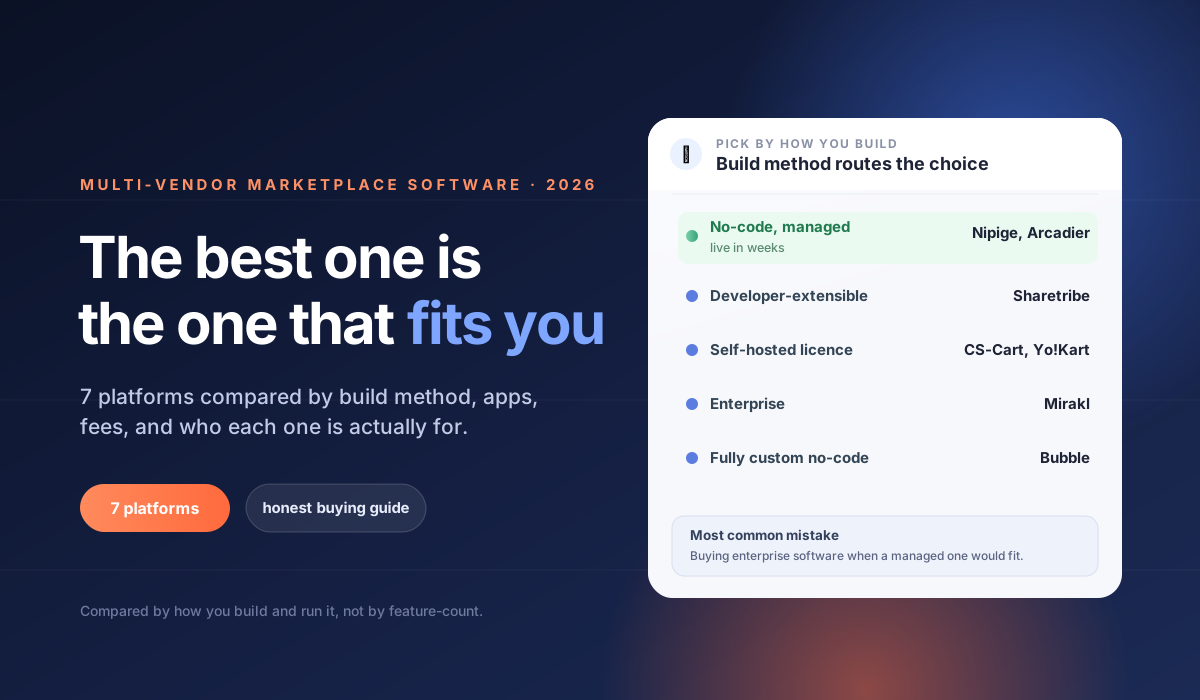
A food delivery app costs anywhere from a few thousand dollars to well over $200,000, depending on how you build it. A custom build from an agency is the most expensive; a no-code platform like Nipige is the cheapest, launching a branded app in about 14 days on a flat monthly plan.
If you are pricing a food delivery app this year, you have probably seen quotes that range from a few thousand dollars to well over two hundred thousand. Both can be honest. The number depends on how many apps you build, which features you turn on, who writes the code, and whether you build from scratch or start from a ready platform. This guide breaks the cost down part by part so you can read any quote and know what you are actually paying for.
How much does food delivery app development cost in 2026?
A food delivery app costs roughly $20,000 to $40,000 for a basic custom build, $50,000 to $120,000 for a full-featured multi-restaurant platform, and $150,000 and up for an enterprise product with custom logistics. A DoorDash-class platform commonly runs $180,000 to $350,000 or more. These are 2026 development-agency ranges, reported consistently by SoftTeco, Code-Brew, and Folio3. A no-code or white-label path lands far lower, often a flat monthly subscription instead of a large one-time bill. The spread comes from four things: the number of apps, the feature set, the development team's hourly rate, and the build method.
What actually drives the cost of a food delivery app?
Five factors move the price more than anything else. Everything on a quote traces back to one of them.
- Number of apps. A real food delivery marketplace is not one app. It is usually four: a customer app, a restaurant or vendor app, a driver app, and an admin panel. Each is a separate build.
- Feature depth. Live order tracking, driver assignment, in-app payments, ratings, and promotions each add engineering time. A menu-and-checkout app costs a fraction of a full logistics platform.
- Platform coverage. iOS plus Android plus a web app is three targets. Native builds cost more than a single cross-platform codebase.
- Team rate and location. The same app costs two to four times more built by a US agency than by a team in Eastern Europe or South Asia. This is the single biggest lever on a custom quote.
- Build method. Custom code, no-code platform, or white-label. This decides whether you pay once and wait months, or subscribe and launch in weeks.
Grocery apps cost more because of the large product catalog and live inventory. If that is your model, see building a grocery app like Instacart.
How much does each part cost to build?
Here is a typical split for a custom food delivery app development project with all four apps. Treat these as planning ranges, not fixed prices.
| Component | What it does | Typical custom range |
|---|---|---|
| Customer app | Browse, cart, checkout, order tracking, ratings | $8,000 to $25,000 |
| Vendor / restaurant app | Menu management, incoming orders, status updates | $6,000 to $18,000 |
| Driver app | Accept jobs, navigation, delivery confirmation | $6,000 to $18,000 |
| Admin panel | Catalog, zones, payouts, reporting, refunds | $8,000 to $22,000 |
| Backend and APIs | Database, auth, payments, notifications, hosting setup | $10,000 to $30,000 |
| Design (UI/UX) | Wireframes, visual design, prototypes | $5,000 to $15,000 |
Agencies group these line items differently, so treat the split as planning ranges inside the sourced $50,000 to $120,000 mid-range total, not fixed prices. Add the rows and a mid-range four-app platform sits in that band in pure development, before ongoing costs.
Custom build, no-code, or white-label: which is cheaper?
For most founders, the build method decides the budget more than the feature list does. There are three real paths.
Custom development means an agency or in-house team writes every line. You own the code and can build anything. You also pay the full price above, wait several months, and carry maintenance yourself. It fits companies with a genuinely novel model and the capital to fund it.
No-code and low-code platforms let you configure an app instead of coding it. Cost drops sharply and launch time falls to weeks. The trade is that you work within the platform's features rather than inventing your own.
White-label food delivery apps ship a finished, proven app that you rebrand as your own. This is the fastest and usually the cheapest route to a live marketplace, because the customer, vendor, driver, and admin apps already exist and only need your branding, zones, and payment setup. A white label food delivery app turns a six-figure build into a subscription.
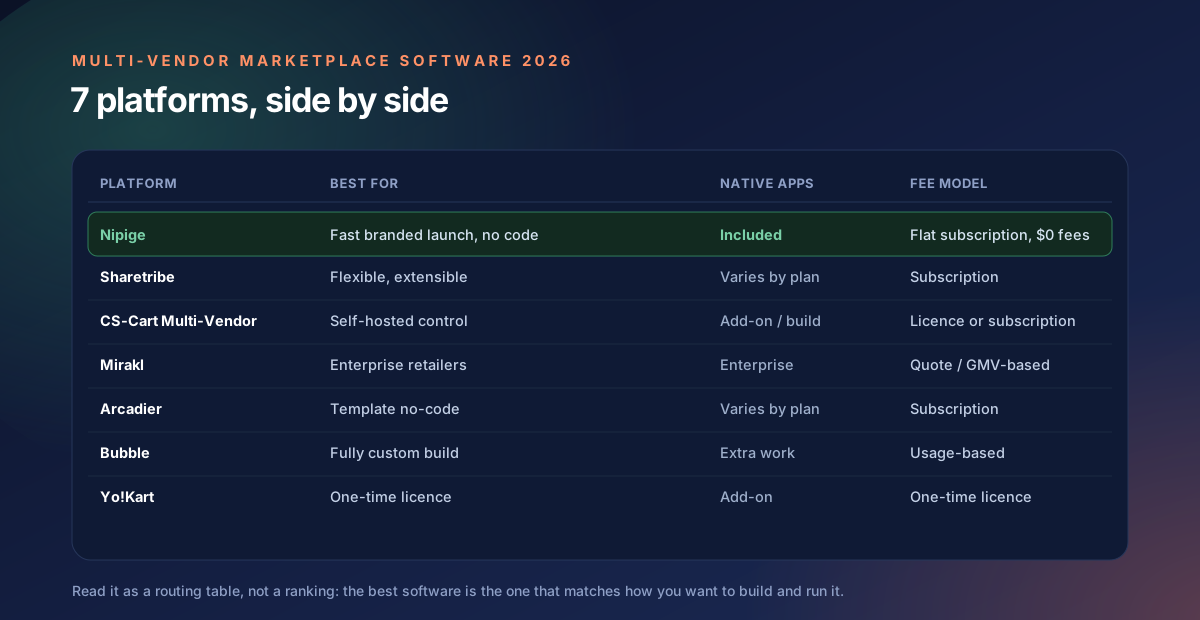
The right choice depends on how different your idea really is from what already works. If you need a standard restaurant-to-customer marketplace, paying to rebuild it from zero rarely earns its cost back.
Which features add the most to the bill?
Some features are cheap and expected. Others are where budgets quietly double. The expensive ones tend to be the real-time and money-handling parts.
- Live order and driver tracking. Real-time location on a map needs mapping APIs, sockets, and testing across weak networks. It is one of the priciest single features.
- Driver assignment logic. Sending the right order to the right driver at the right time is a system, not a screen.
- In-app payments and payouts. Splitting each order between the platform, the restaurant, and the driver, and paying everyone correctly, takes real engineering and compliance care.
- Promotions, coupons, and loyalty. Each rule you add is code someone has to write and maintain.
- Multi-language and multi-currency. Cheap to plan for at the start, expensive to bolt on later.
A useful rule when you read a quote: the closer a feature is to money moving or a vehicle moving, the more it costs.
How does team location change the price?
The same food delivery app development scope can carry very different price tags depending on where the team sits, because the work is billed by the hour and hourly rates vary widely by region.
- United States and Western Europe: roughly $100 to $250 per hour for senior developers.
- Eastern Europe: roughly $35 to $90 per hour.
- South Asia: roughly $15 to $65 per hour.
Those bands are from FullStack's 2026 software development price guide and Uvik's 2026 rate data. A 1,200-hour build near $180,000 at a US rate can cost closer to $50,000 with a skilled team in South Asia. Rate is not quality, but it is the reason two honest quotes for the same app can differ by three times.
What are the hidden and ongoing costs?
The build price is the part everyone quotes. The running costs are the part that surprises people in month two. Budget for these from the start.
- Maintenance: plan for roughly 15 to 20 percent of the build cost per year for updates, OS changes, and bug fixes. On a $100,000 build that is $15,000 to $20,000 a year, and it often runs higher in year one. This 15 to 20 percent rule is a standard industry benchmark, per Aalpha and Cleveroad.
- Hosting and infrastructure: scales with orders, from modest to significant as you grow.
- Payment processing: your gateway's standard fee on every transaction. Stripe's standard US rate is 2.9 percent plus 30 cents per successful card payment, with no monthly fee, per a breakdown of Stripe's processing fees.
- Maps and SMS: mapping and text-notification APIs bill per use and rise with volume.
- App store accounts: an annual Apple developer fee and a one-time Google fee.
None of these are optional. A quote that leaves them out is not cheaper, it is just less complete.
How long does it take, and why does that matter for cost?
Time is cost, because most teams bill by the hour or the month. A basic custom build usually takes four to six months to a first launch, and a full four-app platform eight to fourteen months. A no-code or white-label path can reach a live, branded marketplace in about two weeks, because the apps are already built and you are configuring rather than constructing. Every extra month of custom development is another month of salaries before you have a single paying order.
How can you cut the cost without cutting corners?
You do not have to choose between cheap and good. You have to choose what to build now and what to build later.
- Launch an MVP first. Ship the customer, vendor, and driver flow that lets a real order happen. Add loyalty, analytics, and edge cases once orders are flowing.
- Start from a platform. A white-label or no-code base removes the most expensive line items, the four apps and the backend, and lets you spend only on what makes your marketplace yours.
- Validate before you customize. Prove people will order before you pay to build a custom feature no competitor has.
Where Nipige fits
Nipige is a no-code, white-label marketplace builder. For a food marketplace it ships the four apps a delivery business needs, the customer app, vendor app, driver app, and admin console, already built and ready to brand. You configure your zones, connect Stripe or PayPal, and go live in about 14 days. Food marketplace plans start at $899 a month with $0 platform transaction fees, so you keep your margin and pay only your payment processor's standard rate.
That turns the six-figure custom build described above into a predictable subscription, without writing code. See the food delivery solution for what is included, and the pricing page for current plans.
Frequently asked questions
How much does it cost to build a food delivery app?
A basic custom food delivery app costs roughly $20,000 to $40,000, a full-featured multi-restaurant platform $50,000 to $120,000, and an enterprise product $150,000 and up. A no-code or white-label build is far lower, usually a flat monthly subscription instead of a large one-time cost.
Why do food delivery app quotes vary so much?
Because four things move the price: how many apps you build, which features you enable, the team's hourly rate and location, and whether you build custom or start from a ready platform. Two honest quotes for the same app can differ by three times on rate alone.
Is it cheaper to build a food delivery app or use a white-label platform?
A white-label platform is almost always cheaper and faster for a standard restaurant-to-customer marketplace, because the customer, vendor, driver, and admin apps already exist. Custom development is worth its higher cost only when your model is genuinely different from what already works.
What are the ongoing costs of a food delivery app?
Plan for maintenance at roughly 15 to 20 percent of the build cost per year, plus hosting, payment processing fees, mapping and SMS usage, and app store accounts. These run every month regardless of build method.
How long does it take to build a food delivery app?
A basic custom build usually takes four to six months, and a full four-app platform eight to fourteen months. A no-code or white-label path can launch a branded marketplace in about two weeks, because the apps are already built and you are configuring them rather than coding from scratch.
The Nipige team builds and operates production marketplace infrastructure - vendor onboarding, real-time dispatch, payments, and native apps - drawing on 13+ years of enterprise billing and monetization engineering at Trigital Technologies.