Last updated: August 6, 2026
How to Build a Service Marketplace: A Step-by-Step Guide (2026)
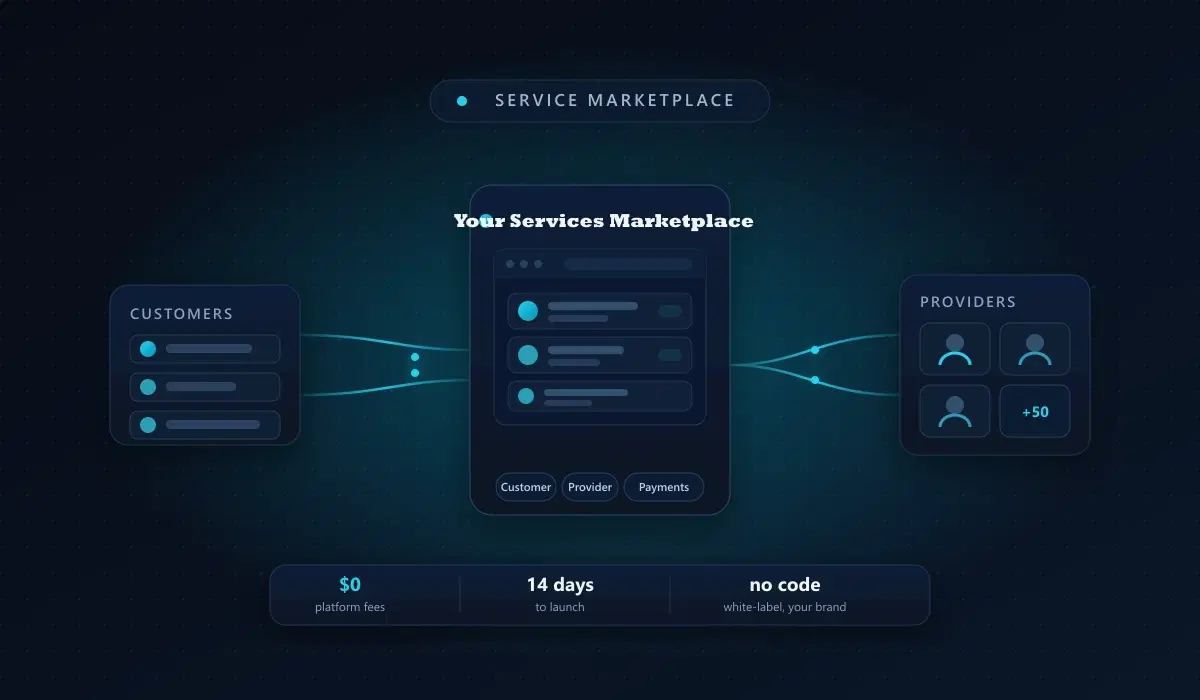
To build a service marketplace you connect customers with providers and handle booking, provider onboarding, job assignment or bidding, payments, and reviews. You can build it custom or configure a ready template on a no-code platform like Nipige, which launches a branded service marketplace with customer, provider, and admin apps in about 14 days.
Updated for 2026: launching a service marketplace no longer means a long custom build. Configure a ready template with booking, provider onboarding, and payouts, and a branded customer, provider, and admin stack goes live in about 14 days from a flat monthly plan.
If you are researching how to build a service marketplace, you want to connect people who need a service, home cleaning, repairs, tutoring, beauty, with the providers who deliver it, all under your brand. This guide covers what you have to build and the three ways to build it.
A service marketplace is not one app. It is a few connected pieces, and the parts you do not see as a customer are where the real work sits.
What is a service marketplace?
A service marketplace is a branded platform where customers find, book, and pay service providers in one place, while you, the owner, run the marketplace and set the commission or subscription. Thumbtack, Urban Company, and TaskRabbit are service marketplaces. So is a branded home-services or professional-services platform you launch yourself.
Why build your own service marketplace?
Demand is large and still climbing. The global gig-economy tech-platforms market is set to grow from about $485 billion in 2025 to $1.39 trillion by 2035, a CAGR of 11.1%, according to Fact.MR. Roughly 1.57 billion people freelance worldwide, close to 46% of the global workforce, per Demandsage.
Providers already work this way. The gap is a trusted place to find and book them. Owning that platform means you set the terms, you keep the customer relationship, and your providers stop paying per-lead fees to a platform they do not control.
What are the parts of a service marketplace?
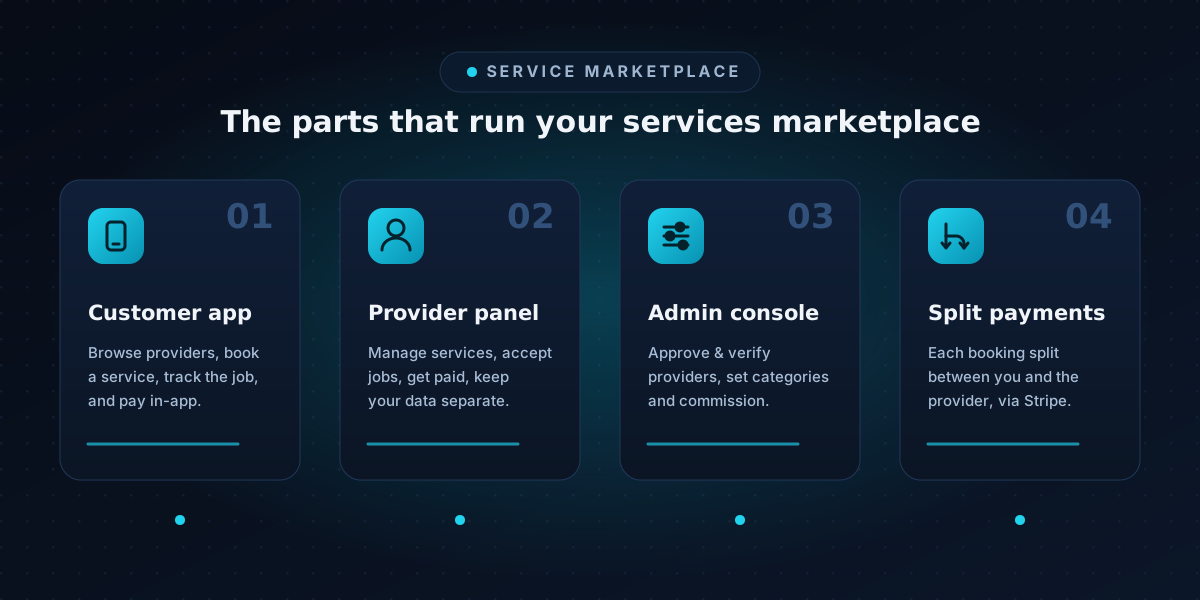
Every service marketplace needs these pieces working together, all under your brand:
- A customer app. Browse and search providers, view profiles and ratings, book or request a service, track the job, and pay in-app.
- A provider panel. Each provider manages their services and availability, accepts or declines jobs, handles bookings, and gets paid, with their data kept separate.
- An admin console. You approve providers, verify them (KYC), set categories, commission, and zones, handle disputes, and see the whole marketplace.
- A payments layer. It takes the customer's payment and splits it between you and the provider automatically, through a processor like Stripe or PayPal.
The customer app is the part people see. The provider panel, the verification, and the admin controls are the majority of the build, and they are what a cheap quote tends to leave out.
How to build a service marketplace, step by step
- Pick one service category and one city. Focused marketplaces reach liquidity faster. Start with one trade, such as cleaning or repairs, in one area.
- Sign your first providers. Onboard 10 to 20 providers who will actually take bookings on day one. Supply first, always.
- Design the money flow. Decide your commission or flat subscription, who pays any service fee, and when providers get paid.
- Choose your build route (custom, generic builder, or no-code platform, compared below).
- Set up provider verification and trust. Provider sign-up, KYC, reviews, and clear policies. This is the step new marketplaces underestimate most.
- Connect payments and launch in one area. Go live with your committed providers and a service area you can cover well.
- Grow providers and demand together. Add the services your customers ask for, and market to the customers your providers bring.
What does it cost to build a service marketplace?
It depends entirely on the route you choose.
| Route | Time to launch | Typical cost | You maintain | Best for |
|---|---|---|---|---|
| Custom build (dev agency) | 4 to 9 months | $30,000 to $300,000+ | Everything: servers, updates, fixes | Genuinely unusual logic |
| Generic app builder | Weeks to months | Lower upfront + your time | You: the stitched-together logic | Technical founders with time |
| No-code platform (e.g. Nipige) | ~14 days | Flat monthly subscription | The platform (managed for you) | Owners who want to launch fast |
For the full custom-build numbers, see Cost to Build a Marketplace in 2026. The same on-demand dispatch model is covered from the restaurant side in our DoorDash business-model breakdown.
The three ways to build one
1. Custom build with a development company
You get exactly what you spec, and a bill and timeline to match: typically $30,000 to $300,000+ over 4 to 9 months. You own the code, and every server, update, and change afterward. Right only when your marketplace needs something no platform offers.
2. A generic app builder
Tools like Bubble or a marketplace script let you assemble something without a full dev team, but you still spend weeks wiring up bookings, provider profiles, verification, and payments that were not purpose-built for a services marketplace. You trade money for your own time.
3. A no-code services platform
A purpose-built platform ships the parts already connected and rebranded as yours. This is what Nipige does: a white-label, multi-provider services marketplace you configure instead of code, with $0 platform transaction fees and a launch in about 14 days (from $699/month). You do not rebuild the plumbing; you run the marketplace.
Proof: platforms running at real scale
A template is only worth trusting if it holds real volume. FastForge, built on Nipige, runs 2,000+ orders per day. Teka, a hyperlocal commerce marketplace on the same platform, reports 1M+ shoppers and 15,000+ partner businesses. Different verticals, one platform, both operating at scale.
So which route is right for you?
- Genuinely custom needs (your own matching logic, special integrations)? Hire a development company and budget for it.
- Technical and time-rich? A generic builder can work.
- Want to launch a branded services marketplace in weeks, not spend six figures first? A no-code, white-label platform is the fastest path.
→ See how to launch a service marketplace on Nipige
Frequently asked questions
How do you build a service marketplace?
You connect a customer app, a provider panel, an admin console, and a payments layer that splits each booking. You can build them custom, assemble them on a generic builder, or configure a no-code platform. A no-code platform like Nipige launches a branded, multi-provider services marketplace in about 14 days without coding.
How much does it cost to build a service marketplace?
A custom build usually costs $30,000 to $300,000+ over 4 to 9 months. A no-code platform is a flat monthly subscription instead (from $699/month), with $0 platform transaction fees, so you launch for far less upfront.
How long does it take to launch a service marketplace?
A custom build takes 4 to 9 months. On a no-code platform like Nipige, a branded, multi-provider services marketplace can go live in about 14 days.
Can I build a service marketplace without coding?
Yes. A no-code platform lets you configure providers, service categories, booking rules, and branding instead of writing code. The customer app, provider panel, admin console, and payments are already built.
What is the hardest part of building a service marketplace?
Trust and supply. Customers only book providers they trust, so provider verification, reviews, and enough available providers in each category are what make or break a new services marketplace.
The Nipige team builds and operates production marketplace infrastructure - vendor onboarding, real-time dispatch, payments, and native apps - drawing on 13+ years of enterprise billing and monetization engineering at Trigital Technologies.