Last updated: August 6, 2026
Mirakl Alternative for Mid-Market: 7 Marketplace Platforms Compared in 2026
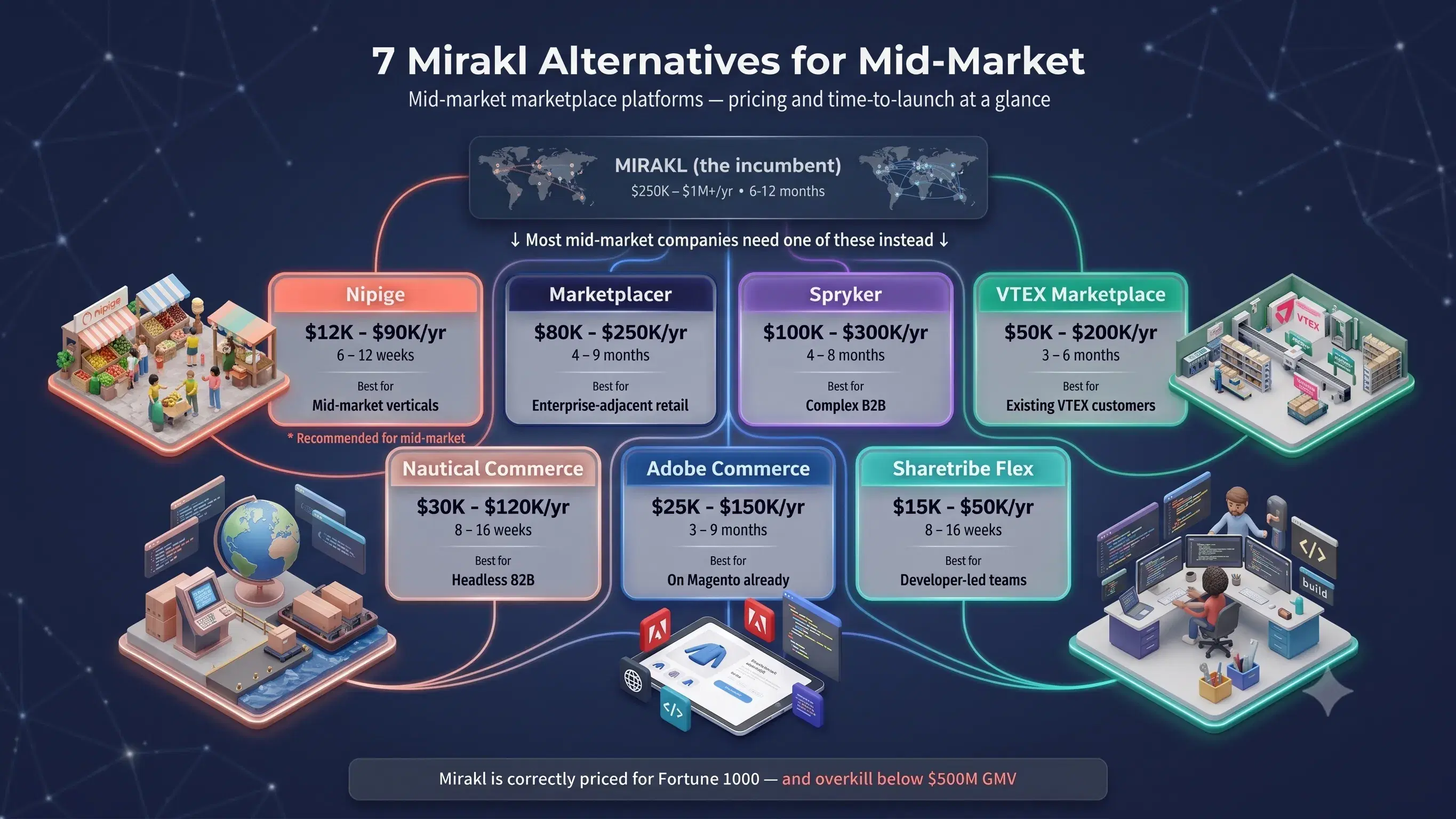
Mirakl is enterprise marketplace software aimed at large retailers with big budgets and development teams. If you want a faster, lower-cost route, Nipige is a no-code, white-label alternative that ships vertical-ready templates and branded apps, launching in about 14 days on a flat monthly plan instead of a large enterprise contract.
If you've been pitched Mirakl and walked out with a $750K annual quote, a 9-month implementation timeline, and a sinking feeling that this is too much platform for your business, you're not wrong, and you're not alone.
Mirakl is genuinely excellent. They didn't become the category-defining enterprise marketplace platform by accident. Carrefour runs on Mirakl. Macy's runs on Mirakl. So do H&M, Best Buy, Express, and Urban Outfitters. For Fortune 1000 retailers with $500M+ in marketplace GMV trajectories, Mirakl is the right answer with no asterisk.
For everyone else, mid-market e-commerce in the $50M to $500M range, growing B2B distributors, scaling vertical marketplaces, Mirakl is over-engineered, over-priced, and built around a procurement cycle that doesn't match how you move. This guide gives you the seven realistic Mirakl alternatives, their actual pricing (where we can verify it), implementation timelines, and a decision matrix for picking the right one for your stage.
Updated for 2026: more mid-market buyers are skipping enterprise platforms like Mirakl for no-code, managed alternatives that launch in weeks, not months. If your GMV ceiling is under roughly 5 million dollars, a turnkey platform gets you live faster and keeps your margin, with $0 platform transaction fees.
TL;DR: 7 Mirakl Alternatives at a Glance
| Platform | Starting price | Time to launch | Best for |
|---|---|---|---|
| Nipige | ~$8.4K to $54K+/yr ($699 to $4,499+/mo) | 6 to 12 weeks | Mid-market verticals, B2B2C, aggregators |
| Marketplacer | ~$80K to $250K/yr | 4 to 9 months | Enterprise-adjacent retail, ANZ market |
| VTEX Marketplace | ~$50K to $200K/yr | 3 to 6 months | Existing VTEX commerce customers |
| Spryker Marketplace | ~$100K to $300K/yr | 4 to 8 months | Composable commerce, B2B-heavy |
| Nautical Commerce | ~$30K to $120K/yr | 8 to 16 weeks | B2B marketplaces, headless setups |
| Adobe Commerce + Multi-Vendor | ~$25K to $150K/yr | 3 to 9 months | Existing Magento/Adobe Commerce shops |
| Sharetribe (Extend) | ~$4K/yr platform + transaction fees | 8 to 16 weeks | Developer-led teams, custom logic |
The pricing figures above are based on publicly available vendor pricing, checked July 2026. Where exact figures are gated (which is most enterprise marketplace pricing), we've shown ranges from real customer quotes. Always confirm directly.
Sharetribe's Extend plan is $299/month. The wide real-world range comes from per-transaction fees ($0.19 or less per initiated transaction past your allowance), not the licence.
For deeper coverage of the broader marketplace platform landscape (including Sharetribe-vs-platforms comparisons), see our Sharetribe alternative guide, there's overlap with the platforms covered here, but the cost tier and fit are different.
Why Mirakl Might Not Be the Right Fit (the Honest Version)
Before we get to the alternatives, let's be clear about what Mirakl actually is and where it wins.
Where Mirakl is the correct answer:
- Fortune 1000 retailers and distributors
- $500M+ in target marketplace GMV
- Multi-region, multi-language, multi-currency from day one
- Enterprise procurement cycles that can absorb 6 to 9 month sales conversations
- Existing IT infrastructure with dedicated integration teams
- Need for Mirakl Connect, the curated supplier network, to accelerate seller onboarding
Where Mirakl becomes the wrong answer:
-
Pricing. Real customer quotes for Mirakl in 2024 to 2025 ranged from $250K to over $1M per year for the platform alone, with separate fees for Catalog Manager, Mirakl Ads, and Connect. Implementation services (often delivered by Accenture, Capgemini, or Mirakl Solutions Partners) typically add another $200K to $500K in Year 1. For sub-$50M marketplace GMV, the math doesn't work.
-
Implementation timeline. Mirakl implementations realistically run 6 to 12 months. Some go faster with disciplined scoping; many run longer with scope creep. If your business needs to launch a marketplace in Q2 and it's already Q1, Mirakl is not the answer.
-
Procurement velocity. Mirakl is sold through enterprise procurement. Expect MSAs, security reviews, vendor risk assessments, and quarterly stakeholder reviews. Founder-led companies that can decide on a tool in a week find this exhausting.
-
Over-spec for your problem. Mirakl is designed for retailers operating marketplaces with thousands of sellers, hundreds of thousands of SKUs, and complex catalog hierarchies. If your marketplace will have 50 to 500 sellers and 5K to 50K listings, you're paying for capability you'll never use.
-
Lock-in. Migrating off Mirakl is genuinely difficult once you've built workflows around its catalog model, seller onboarding pipelines, and reporting hierarchy. This is true of any deeply integrated platform, but Mirakl's specificity makes the migration cost higher than average.
If two or more of those apply to you, the alternatives below are worth your time.
The 7 Mirakl Alternatives: Detailed Breakdown
1. Nipige: Purpose-Built for Mid-Market Verticals
Nipige sits in the gap between Sharetribe-class platforms (great for early validation, ceiling around $5M GMV) and Mirakl-class platforms (enterprise overkill below $500M GMV). Nipige is built specifically for the mid-market segment, companies running $5M to $200M in marketplace GMV that need real multi-vendor primitives without the enterprise procurement overhead.
Want to compare Nipige and Mirakl in detail? See our dedicated comparison page.
Pricing: $699 to $4,499+/month, flat-rate (no per-transaction take that punishes growth).
Time to launch: 6 to 12 weeks for a customized deployment.
Strengths:
- Configurable vendor onboarding workflows out of the box
- Multi-tier commission structures as a first-class primitive (not a Flex-only feature)
- Built for vertical marketplaces: home services, B2B distribution, service aggregators, hyperlocal
- Founder-friendly procurement, no MSAs to wade through for the entry tier
Where Nipige is the wrong choice: if you're a Fortune 1000 retailer with 10,000+ sellers and need Mirakl Connect's supplier network, Nipige doesn't compete at that scale. Be honest about your scale.
For a head-to-head Nipige vs Sharetribe comparison (a different but related comparison), see the Sharetribe alternative breakdown.
2. Marketplacer: Closest Direct Mirakl Competitor
Marketplacer is the closest competitor to Mirakl by capability and target customer. Australian-founded, global presence, enterprise-grade architecture. Customer roster includes ANZ retailers (Bunnings, Myer) and increasingly North American mid-market.
Pricing: Based on publicly available data and customer disclosures, Marketplacer typically lands in the $80K to $250K/year range, meaningfully less than Mirakl but still firmly enterprise pricing.
Time to launch: 4 to 9 months.
Strengths:
- Strong fit for enterprise-adjacent retail expansion
- Robust catalog management
- Good ANZ market penetration if that's your geography
- Solid integration ecosystem (Shopify Plus, BigCommerce, Adobe Commerce)
Where Marketplacer fits well: mid-market retail that wants Mirakl-like capability without Mirakl's price tag and is comfortable with a 6 to 9 month enterprise implementation. Less suitable for pure B2B or service marketplaces.
3. VTEX Marketplace: For Existing VTEX Customers
VTEX is a composable commerce platform with a built-in marketplace module. If you're already on VTEX, adding marketplace functionality is a relatively clean expansion. If you're not on VTEX, it's a much bigger commitment.
Pricing: VTEX commerce starts around $30K to $50K/year for the core platform; adding the marketplace module typically pushes you into the $50K to $200K/year range total.
Time to launch: 3 to 6 months if you're already on VTEX; 6 to 12 months including the commerce platform migration if you're not.
Strengths:
- Composable architecture, pick the modules you need
- Strong in LATAM markets
- Good multi-tenant support
Where it fits: existing VTEX customers expanding into marketplace functionality. Less compelling as a standalone marketplace platform decision.
4. Spryker Marketplace: Composable Commerce with Marketplace
Spryker is German-founded composable commerce with strong B2B focus and a dedicated Marketplace product. Highly modular, very developer-friendly, and well-suited to complex B2B catalog and pricing logic.
Pricing: $100K to $300K/year typical range, with implementation services often doubling Year 1 cost.
Time to launch: 4 to 8 months.
Strengths:
- Strong B2B capability (bulk pricing, RFQ workflows, account hierarchies)
- Truly modular, only buy what you need
- Open codebase, well-documented APIs
- Active developer community
Where it fits: B2B-heavy marketplaces, distributors, and companies that need to deeply customize. Overkill for pure B2C retail expansion.
5. Nautical Commerce: Newer Entrant, B2B Focus
Nautical is a more recent platform (founded 2020) focused on headless, API-first B2B marketplace deployments. Built specifically for the "we want to launch a marketplace but don't have an existing commerce stack" use case.
Pricing: Approximately $30K to $120K/year based on customer disclosures.
Time to launch: 8 to 16 weeks.
Strengths:
- Modern API-first architecture
- B2B-native (multi-currency, account hierarchies, custom pricing)
- Faster to launch than Spryker or Mirakl
- Active product development
Where it fits: B2B-first marketplaces, headless commerce architectures, mid-market companies launching new marketplace lines of business. Less mature ecosystem than Mirakl or Marketplacer.
6. Adobe Commerce + Multi-Vendor Extension
If you're already running Adobe Commerce (formerly Magento), several multi-vendor extensions (Webkul Marketplace, CedCommerce, Magenest) turn your existing commerce into a marketplace.
Pricing: Adobe Commerce licensing varies wildly ($25K to $150K+/year). Multi-vendor extension licenses run $500 to $3K one-time. Implementation + customization typically $30K to $100K Year 1.
Time to launch: 3 to 9 months depending on customization depth.
Strengths:
- Leverages existing Adobe Commerce investment
- Large pool of certified developers
- Extensive third-party integration library
Where it fits: companies already deeply on Magento/Adobe Commerce who want to expand into marketplace functionality. Not recommended as a green-field marketplace decision, the underlying platform's complexity isn't justified if you're not already using it.
7. Sharetribe (Extend): Developer-Led Path
Sharetribe Extend plan is genuinely different from the other six, it's developer-tools-first rather than full-stack-platform-first. You get the open-source Sharetribe Web Template (React) on top of their API.
Pricing: Approximately $15K to $50K/year for Flex API access, plus your engineering team's time (which is often the larger cost).
Time to launch: 8 to 16 weeks with a competent React/Node team.
Strengths:
- Maximum customization flexibility
- You own the codebase
- Smaller monthly platform fees than enterprise alternatives
- Active developer ecosystem
Where it fits: technical founders or marketplaces with strong in-house engineering. Wrong choice if you don't have dedicated engineering and want a faster path to launch, which is most of the mid-market.
Decision Matrix: When Each Alternative Wins
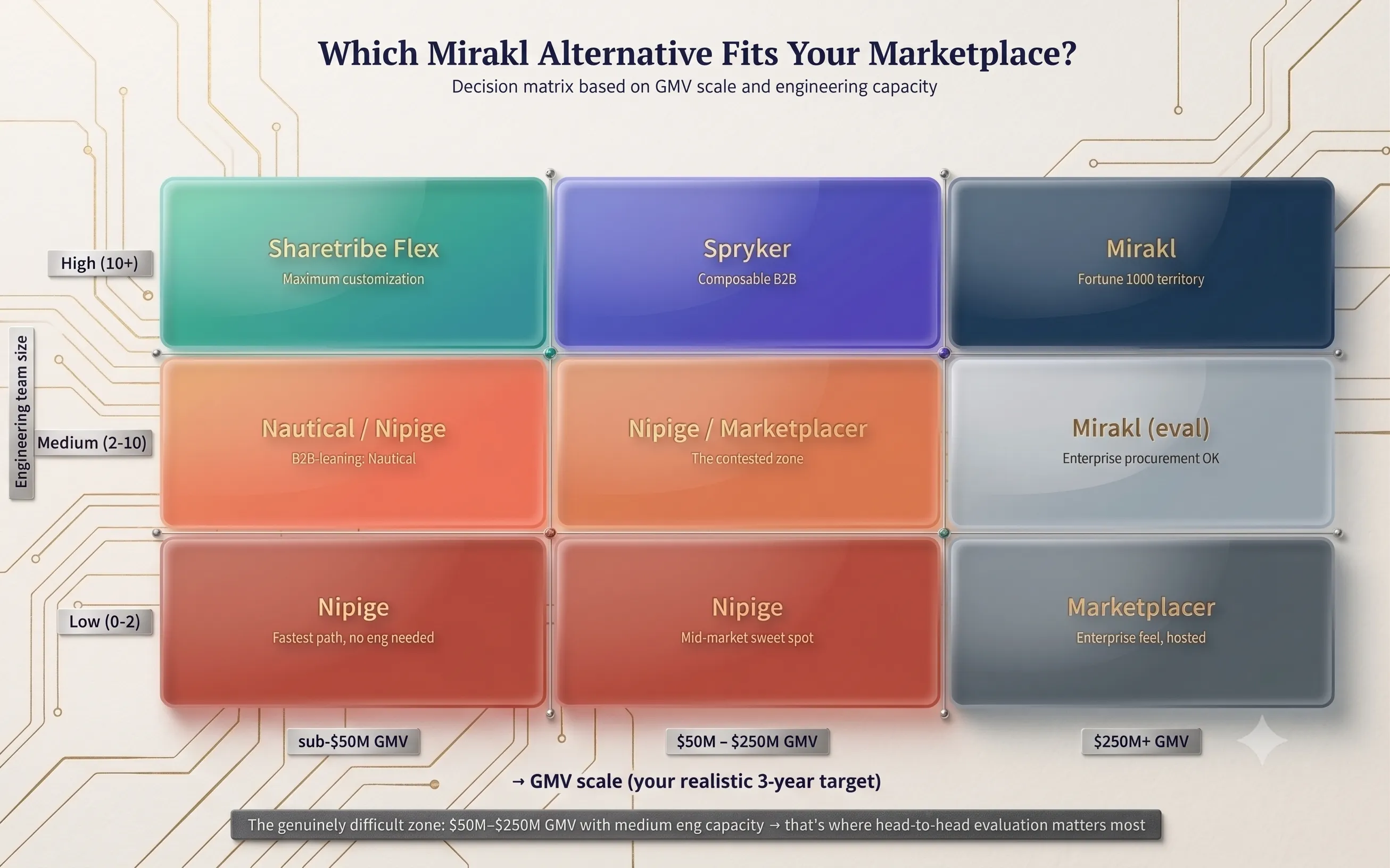
| Your Situation | Best Mirakl Alternative |
|---|---|
| Mid-market vertical marketplace, $5M to $200M GMV target | Nipige |
| Enterprise-adjacent retail with $200M+ GMV trajectory | Marketplacer |
| Already running VTEX for commerce | VTEX Marketplace |
| Complex B2B with bulk pricing, account hierarchies | Spryker or Nautical |
| API-first headless B2B, mid-market scale | Nautical Commerce |
| Already on Adobe Commerce with engineering capacity | Adobe Commerce + extension |
| In-house React/Node team, want maximum flexibility | Sharetribe (Extend) |
| Fortune 1000, $500M+ GMV, enterprise procurement OK | Stay with Mirakl |
For the broader build-vs-buy question (custom development vs. SaaS platforms vs. open-source), see our cost to build a marketplace guide, it covers the full TCO question across all three paths.
Mirakl vs Nipige: Head-to-Head
Of the 7 alternatives, the most direct comparison for mid-market companies is Mirakl vs Nipige. They serve adjacent customers, Mirakl on the enterprise end, Nipige on the mid-market end, and the question of "do we really need Mirakl, or is Nipige enough?" comes up in roughly every procurement cycle Nipige is part of.
| Dimension | Mirakl | Nipige |
|---|---|---|
| Target customer | Fortune 1000, $500M+ GMV | Mid-market, $5M to $200M GMV |
| Pricing | $250K to $1M+/year | ~$8.4K to $54K+/yr ($699 to $4,499+/mo) |
| Implementation | 6 to 12 months | 6 to 12 weeks |
| Procurement | Enterprise MSA, security reviews | Founder-friendly, monthly contract option |
| Sellers per marketplace (typical) | 1K to 50K+ | 50 to 5K |
| SKU scale (typical) | 100K to 10M+ | 5K to 500K |
| Catalog complexity | Hierarchical, attribute-rich | Configurable, vertical-tuned |
| Multi-tier commissions | Available | First-class primitive |
| Vertical templates | Generic retail-first | Vertical-aggregator-first |
| Supplier network | Mirakl Connect (curated) | Self-onboarding workflows |
| Best at | Enterprise scale & supplier ecosystem | Mid-market velocity & vertical fit |
If your real target is 5K to 50K listings, 50 to 500 sellers, and $10M to $100M in eventual GMV, Nipige is the correct answer. If your real target is 500K+ listings, 5K+ sellers, $500M+ in GMV, Mirakl is the correct answer. The middle ground (50K to 500K listings, 500 to 5K sellers, $100M to $500M GMV) is the genuinely difficult decision space, and that's where the head-to-head conversation actually matters.
Implementation Timeline Reality Check
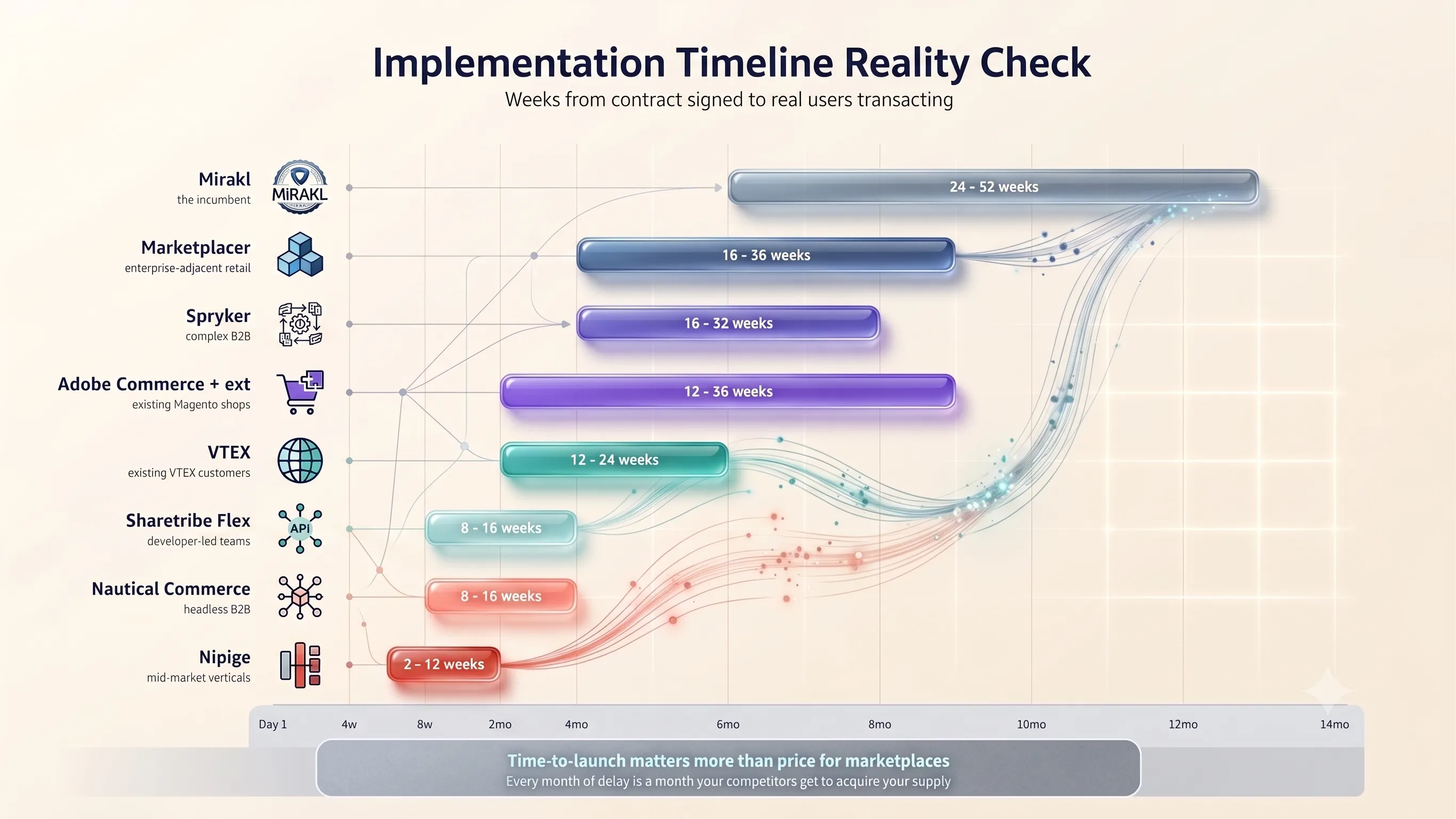
The single most underestimated factor in Mirakl-vs-alternative decisions is implementation time. Mid-market founders often quote me "Mirakl will take a year", and they're roughly right, but they often quote the alternatives as taking "a few months" without specifics. Here's the honest landscape:
| Platform | Realistic timeline | What drives variance |
|---|---|---|
| Mirakl | 6 to 12 months | Catalog complexity, integration depth, enterprise governance |
| Marketplacer | 4 to 9 months | Commerce platform integration, custom workflows |
| Spryker | 4 to 8 months | B2B logic complexity, developer team experience |
| VTEX | 3 to 6 months | Whether you're already on VTEX |
| Adobe Commerce + ext | 3 to 9 months | Extension quality, customization depth |
| Nautical Commerce | 8 to 16 weeks | Headless integration scope |
| Sharetribe (Extend) | 8 to 16 weeks | Your team's React/Node capacity |
| Nipige | 6 to 12 weeks | Vertical customization, vendor onboarding flow |
These timelines are first-launch-to-real-users, not "we have a sandbox set up." Add 30 to 50% buffer if your organization has slow security review cycles or your engineering team has competing priorities.
For more on what actually drives marketplace implementation cost (which correlates strongly with timeline), see the cost to build a marketplace breakdown, the hidden-cost section in particular applies to platform implementations, not just custom builds.
Pricing Reality Check
A point worth making explicitly: enterprise marketplace pricing is genuinely opaque. Nobody publishes their real rate card publicly. The numbers below are based on publicly available vendor pricing, checked July 2026, plus our own engagements with founders evaluating platforms.
| Platform | Year 1 software cost | Year 1 implementation | Year 1 total |
|---|---|---|---|
| Mirakl | $250K to $1M+ | $200K to $500K | $450K to $1.5M+ |
| Marketplacer | $80K to $250K | $50K to $150K | $130K to $400K |
| Spryker | $100K to $300K | $100K to $250K | $200K to $550K |
| VTEX | $50K to $200K | $40K to $120K | $90K to $320K |
| Adobe Commerce | $25K to $150K | $30K to $100K | $55K to $250K |
| Nautical | $30K to $120K | $25K to $75K | $55K to $195K |
| Sharetribe (Extend) | ~$4K platform + transaction fees | engineering time | $50K to $150K |
| Nipige | ~$8.4K to $54K+ | $0 (self-configured, no-code, ~14 days) | ~$8.4K to $54K+ |
The point isn't that Mirakl is overpriced, it's correctly priced for its target market. The point is that mid-market companies regularly buy Mirakl when their actual need maps to a $50K platform with a $20K implementation, and they do it because the enterprise sales cycle made them feel like a serious procurement was the responsible choice.
Frequently Asked Questions
Why is Mirakl so expensive?
Mirakl is priced for its target market, Fortune 1000 retailers and distributors. Their cost structure includes enterprise-grade infrastructure, dedicated CSMs, the Mirakl Connect supplier network as a value-add, professional services partnerships with Accenture and Capgemini, and a sales cycle that absorbs 9 to 18 months of expensive enterprise selling motion. For a Carrefour or Macy's, $750K/year is reasonable. For a $30M e-commerce company, it's misallocated.
Is Mirakl worth it for under $100M GMV?
Almost never. The fixed cost of Mirakl (platform + implementation + ongoing support) eats too much of the contribution margin from a sub-$100M GMV marketplace. The platform's capabilities (supplier network, advanced catalog management, enterprise reporting) are mostly unused at that scale. Marketplacer, Nipige, or Spryker deliver 85% of the practical value at 25 to 40% of the cost.
What's the cheapest Mirakl alternative for a real enterprise feel?
For "enterprise feel" without enterprise pricing, the strongest candidate is Marketplacer. It's architected for enterprise needs but priced at roughly 1/3 of Mirakl. Spryker is the second strongest if your needs are B2B-heavy. Beyond that, you're trading the enterprise feel for either pricing efficiency (Nipige, Nautical) or maximum customization (Sharetribe Extend).
Can I migrate from Mirakl to another platform later?
Yes, but plan for genuine migration cost. Mirakl-to-Marketplacer is the cleanest path, similar catalog model. Mirakl-to-headless or Mirakl-to-Sharetribe is significantly more work because the underlying data models differ. Typical migration projects run 6 to 12 months and $200K to $500K. The alternative, committing to a wrong platform for 5 years, is usually more expensive than the migration.
The Next Step
The right Mirakl alternative depends on three things, in order: your actual target GMV, your in-house engineering capacity, and your tolerance for enterprise procurement cycles.
For mid-market companies, the segment where most "should we get Mirakl?" conversations happen, the realistic answer is one of: Marketplacer (if you want Mirakl-feel at lower cost), Nipige (if you want mid-market-purpose-built with fast time to value), or Sharetribe on the Extend plan (if you have strong developers and want maximum control).
If your target is $5M to $200M in marketplace GMV, you're building a vertical aggregator, B2B2C, or service-marketplace use case, and you want to ship in 6 to 12 weeks rather than 6 to 12 months, Nipige is purpose-built for exactly this segment. Flat-rate pricing, no per-transaction take, vendor onboarding as a first-class primitive, and procurement that fits founder-led companies rather than Fortune 1000 RFP cycles.
Book a 20-minute walkthrough → Real demo against your specific marketplace use case, with transparent pricing and an implementation timeline you can plan a launch around.
The Nipige team builds and operates production marketplace infrastructure - vendor onboarding, real-time dispatch, payments, and native apps - drawing on 13+ years of enterprise billing and monetization engineering at Trigital Technologies.