How to Build a Real Estate Marketplace: Listings, Rentals & Property Management (2026 Guide)
To build a real estate marketplace you need more than listings: search and filters, tenant or buyer applications, rent collection or payments, maintenance requests, and an admin console. You can build custom or configure a ready platform like Nipige, which launches a branded real estate marketplace without code in about 14 days.
Most "real estate marketplace" guides stop at the listings page — search filters, photos, a contact form. That's the easy 20%. The part that actually determines whether operators stick with a platform is everything that happens after a prospective tenant finds a property: the application, the lease, the first month's rent, and the maintenance request that comes in six weeks later.
This guide covers what a real estate marketplace platform actually needs to be, the features beyond search that separate a real product from a directory, realistic cost ranges, and a step-by-step plan to launch one.
What a Real Estate Marketplace Platform Actually Is
A single-agent website lists properties for one broker. A real estate marketplace platform is different in the same way any multi-vendor marketplace is different: many landlords, property managers, or agencies operate under one system, each managing their own units, leases, and tenants — while the platform provides the shared infrastructure underneath: search, applications, payments, and communication.
That shared infrastructure has to cover three distinct relationships at once — the prospective tenant searching for a home, the current tenant paying rent and requesting maintenance, and the landlord or property manager running the portfolio. Most "just build a listings page" approaches solve only the first one.
Real Estate Marketplace vs Listings Site vs Generic Property CRM
| Dimension | Listings website | Generic CRM | Real Estate Marketplace Platform |
|---|---|---|---|
| Property search | Yes | No | Yes — filterable, with photos and virtual tours |
| Online applications & e-signatures | Rarely | No | Yes |
| Rent collection | No | No | Yes — automated, multi-method |
| Maintenance dispatch | No | Sometimes (manual) | Yes — routed to providers, tracked |
| Tenant self-service portal | No | No | Yes |
| Multi-property / multi-manager | Depends | Yes | Yes, with portfolio isolation |
A listings site gets prospects to a property. A real estate marketplace platform runs the relationship from search through move-out.
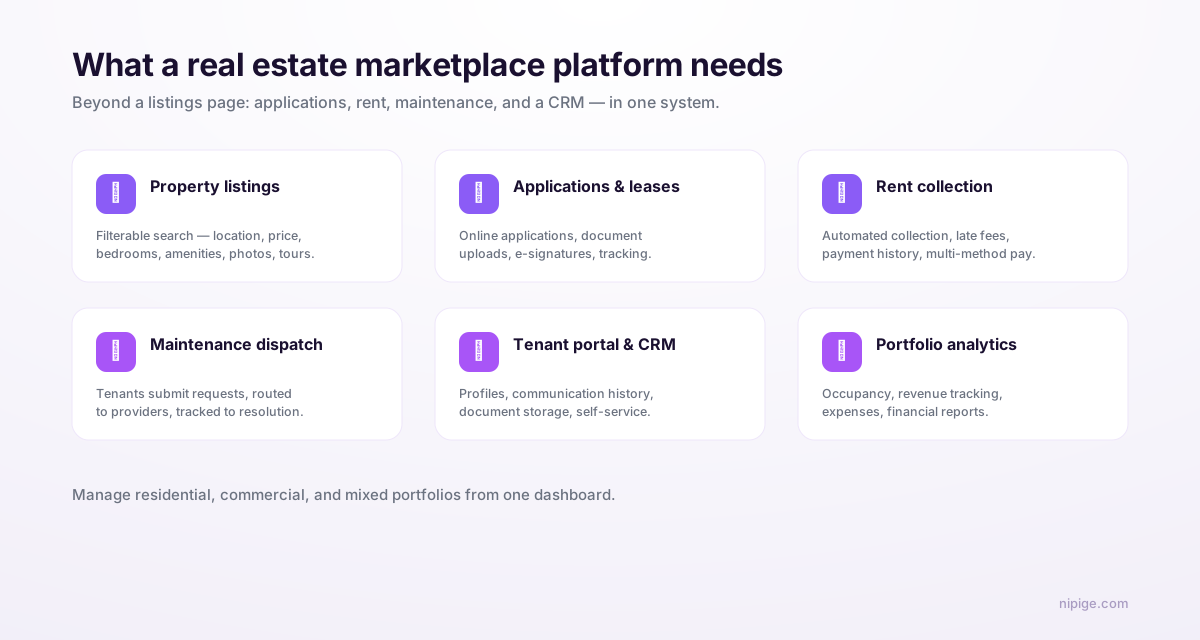
The 6 Features a Real Estate Marketplace Needs Beyond a Listings Page
1. Property Listings
Search with filters — location, price, bedrooms, amenities — plus photos and virtual tours. This is table stakes, and most platforms get it right. It's everything below this list that separates a real platform from a directory.
2. Applications and Lease Management
Prospective tenants apply online, upload documents, and sign leases electronically. Property managers track every application's status without a shared spreadsheet or an inbox full of PDFs.
3. Rent Collection
Automated rent collection with late fees, full payment history, and support for multiple payment methods. This is the feature that turns a listings tool into something a property manager actually runs their business on.
4. Maintenance Request Dispatch
Tenants submit a request from the portal; it routes to the right service provider; the manager tracks it through to resolution. Without this, maintenance lives in text messages and gets lost.
5. Tenant Portal and CRM
Tenant profiles, communication history, and document storage in one place, with self-service for the things tenants shouldn't need to call about — payment history, lease documents, maintenance status.
6. Multi-Property Portfolio Management and Analytics
Occupancy rates, revenue tracking, and expense management across residential, commercial, or mixed portfolios — from one dashboard, with each property manager or landlord scoped to only their own portfolio.
What It Costs to Build a Real Estate Marketplace
The same three paths apply here as any multi-vendor marketplace:
- Custom development: the full feature set above — listings, applications, payments, maintenance dispatch, and a CRM — typically represents 12+ engineer-months for an experienced team, before ongoing maintenance.
- Generic property-management software plus a public listings site bolted on: usually two separate tools kept in sync manually, with real integration cost and ongoing data-drift risk.
- Purpose-built real estate marketplace platform: launch in about 14 days, configuring rather than building, with listings, applications, rent collection, maintenance dispatch, and the CRM as one connected system from the start.
For the full cost breakdown across marketplace types, see our complete guide to marketplace build costs in 2026.
Step-by-Step: Launch a Real Estate Marketplace
Step 1 — Decide your model
Rental marketplace (many independent landlords listing directly), property management platform (you or your clients manage the portfolios), or both. This determines whether you need multi-manager portfolio isolation from day one.
Step 2 — Configure listings and payments
Set up property types, amenity fields, and photo/tour requirements. Connect your payment processor for rent collection and application fees.
Step 3 — Set up the tenant portal and maintenance routing
Configure the maintenance categories and which providers requests route to. Turn on tenant self-service for payment history and lease documents.
Step 4 — Onboard your first properties
Get real listings live — complete profiles with photos, accurate pricing, and amenities filled in — before opening to prospective tenants. Incomplete listings convert far worse than a smaller number of complete ones.
Step 5 — Launch and monitor the full lifecycle
Watch a full cycle — search, application, lease signing, first rent payment, first maintenance request — for your earliest properties. That end-to-end path is where gaps show up, not in the listings page itself.
Frequently Asked Questions
Is a real estate marketplace the same as a listings website?
No. A listings website shows properties. A real estate marketplace platform adds the transaction layer around those listings — applications, e-signatures, rent collection, maintenance dispatch, and a CRM — so operators run the whole relationship, not just the search.
Do I need separate software for rent collection and maintenance requests?
Not if you pick the right platform. On Nipige's real estate template, rent collection, maintenance dispatch, and the tenant portal are one system with shared data, instead of three tools you have to keep in sync manually.
Can one platform handle both rental marketplaces and property management?
Yes, when the platform is built around a shared multi-property data model — portfolios, units, tenants, and providers — with listings and applications on one side and rent collection and maintenance on the other.
How long does it take to launch a real estate marketplace?
With a purpose-built platform: about 14 days to configure branding, listings, payment methods, and tenant-portal fields. A custom build covering the same feature set typically runs 4–9 months.
Do you charge commission on rent or lease transactions?
No — Nipige's Real Estate template runs on a flat monthly subscription with $0 platform transaction fees; you pay only your payment processor.
The Next Step
Nipige's Real Estate & Property template ships listings, applications, rent collection, maintenance dispatch, a tenant portal, and portfolio analytics as one connected system — not three tools you stitch together — from $899/month with $0 platform transaction fees, live in about 14 days.
Book a 20-minute walkthrough → See the tenant portal, rent collection, and maintenance dispatch configured against your own property types.
The Nipige team builds and operates production marketplace infrastructure - vendor onboarding, real-time dispatch, payments, and native apps - drawing on 13+ years of enterprise billing and monetization engineering at Trigital Technologies.