Peer-to-Peer Marketplace: How to Build One (2026 Guide)
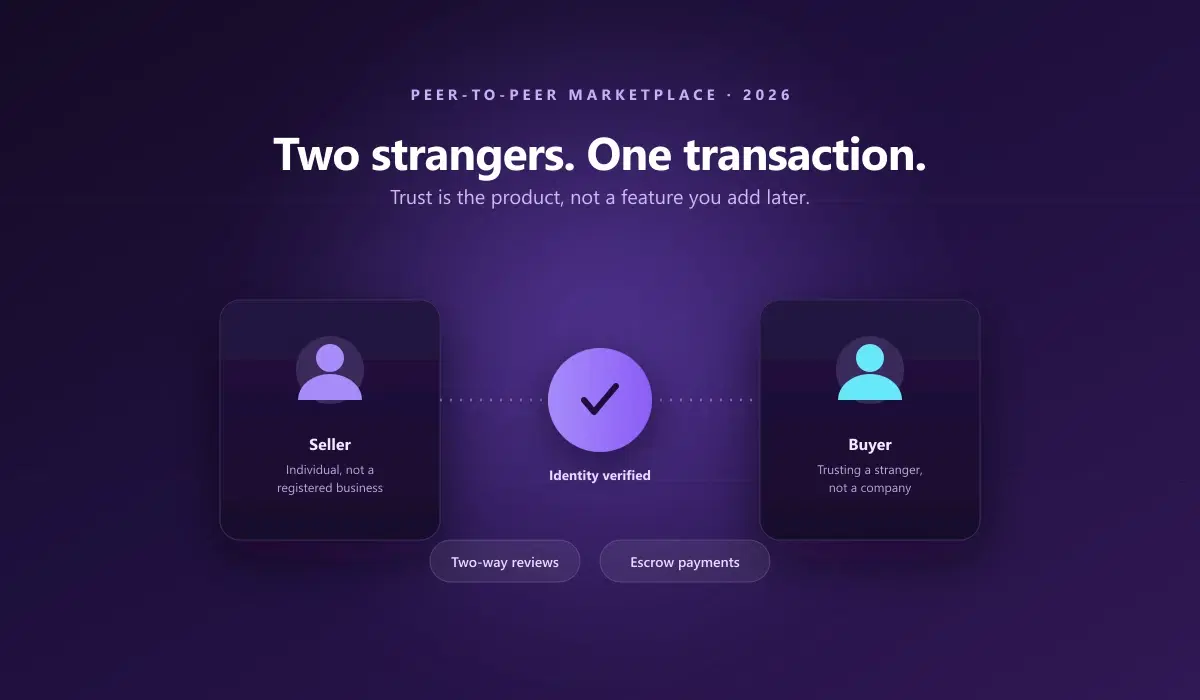
To build a peer-to-peer marketplace you connect individual buyers and sellers directly and add the trust layer that makes strangers transact: identity verification, two-way reviews, and secure payments. You can build custom or configure a no-code platform like Nipige, which launches a branded P2P marketplace with customer and admin apps in about 14 days.
A multi-vendor marketplace connects customers to businesses. A peer-to-peer marketplace connects individuals to other individuals — someone with a spare room, a used bike, or a free afternoon, to someone who wants exactly that. It's the model behind Airbnb, eBay, and TaskRabbit, and it solves a genuinely different problem than a marketplace of registered sellers: how do two strangers trust each other enough to transact, when neither one is a company with a reputation to protect?
This guide covers what makes a marketplace peer-to-peer instead of multi-vendor, the trust features that difference demands, the business model that actually works for individual sellers, and a step-by-step plan to launch one.
What Is a Peer-to-Peer Marketplace?
A peer-to-peer (P2P) marketplace connects individual buyers and sellers directly. The seller isn't a registered business with a storefront and existing reputation — they're a person renting out their apartment for a weekend, reselling something they no longer need, or offering a few hours of their time. The platform's job is to make that transaction between two strangers feel safe enough to actually happen.
P2P vs Multi-Vendor: What Actually Changes
| Dimension | Multi-vendor marketplace | Peer-to-peer marketplace |
|---|---|---|
| Sellers | Registered businesses | Individuals |
| Existing reputation | Often yes (a known brand or storefront) | Usually none |
| Volume per seller | Many transactions | Often one-off or occasional |
| Trust source | Business registration, storefront history | Identity verification, reviews, platform guarantees |
| Typical model | Take-rate or flat subscription | Take-rate per transaction |
The core primitives every marketplace needs (catalog, order routing, payments, admin console) are the same either way — we cover those in our guide to building a multi-vendor marketplace. What's different for P2P is almost entirely in one place: trust.
The Trust Problem: Why P2P Needs More Than a Business Marketplace Does
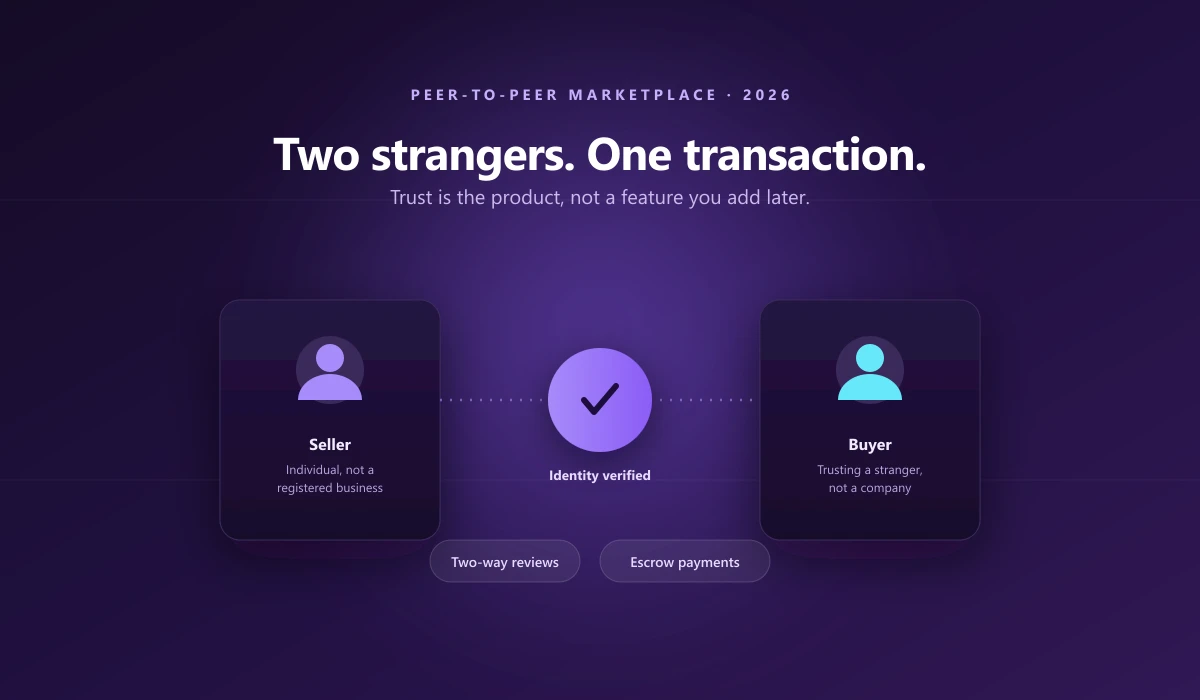
When a customer buys from a registered business, they're trusting a company with a legal identity, a storefront, and something to lose if it behaves badly. When two individuals transact peer-to-peer, neither side has that institutional backing. The platform has to manufacture the trust that a business's reputation would otherwise provide.
That's why every serious P2P marketplace, regardless of vertical, converges on the same three trust mechanics:
- Identity verification. Government ID upload, selfie matching, and phone verification confirm that the person on the other end of the transaction is who they say they are, before money or access changes hands.
- Two-way reviews. Both sides rate each other, and reviews release simultaneously after a hold period so neither side can game the other's rating. This is the single most important trust mechanic P2P marketplaces rely on.
- Platform guarantees or protection programs. A damage guarantee for a rental, buyer protection for a resold item, or a dispute-resolution process gives both sides a backstop when something goes wrong between two people who've never met.
Skip any of these, and a P2P marketplace stalls, because strangers simply won't transact with each other without them.
Core Features a P2P Marketplace Needs
Beyond the multi-vendor primitives (catalog or listings, payments, admin console), a P2P marketplace specifically needs:
- Individual seller onboarding with identity verification, not business registration.
- In-app messaging so buyer and seller can coordinate details without exchanging personal contact information.
- Escrow-style payments that hold funds until the transaction is confirmed complete, protecting both sides.
- A dispute and refund process built for "this wasn't as described" or "the guest damaged something," not just standard e-commerce returns.
- Location and proximity matching, since most P2P transactions (a rental, a resold item, a favor) are inherently local.
What Business Model Works for P2P?
Individual sellers who list occasionally won't pay a recurring software subscription for something they use a few times a year. That rules out flat-subscription pricing as the primary model for most P2P marketplaces — it works well for businesses running a marketplace at volume, but not for a one-off seller.
Commission per transaction is the standard answer: the platform takes a percentage only when a transaction actually happens, which matches the seller's own occasional usage pattern. The rate has to stay low enough that using the platform still beats transacting informally outside it — high enough to sustain trust-and-safety operations, low enough that sellers don't route around you.
Step-by-Step: Launch a Peer-to-Peer Marketplace
Step 1 — Pick a category and a single city
P2P marketplaces live or die on density. A wide geography with thin supply feels empty; the same number of listings concentrated in one city feels alive. Start narrow.
Step 2 — Build the trust layer first
Identity verification, two-way reviews, and your dispute policy need to exist before you onboard a single real user, not after. Trust is the product here, not a feature you add later.
Step 3 — Recruit your first sellers manually
Don't wait for individuals to discover your platform organically. Recruit the first 20–50 sellers directly, with a founding-seller incentive (reduced or waived commission for early listings) in exchange for completed profiles and real reviews.
Step 4 — Launch to a closed, local buyer group
Open to a small, geographically concentrated group of buyers first. Watch the first transactions happen end to end, and fix what breaks before opening wider.
Step 5 — Scale supply and demand together
Add sellers your buyers are asking for, and market to the buyers your sellers need. Neither side grows in isolation in a P2P model.
P2P Across Verticals
The same trust-first pattern applies whether the peer-to-peer transaction is a place to stay, a service, or a resold item. Nipige's Real Estate & Property template supports peer-to-peer rental listings alongside operator-managed portfolios. The Services Marketplace template handles individual providers offering their time, with built-in verification and two-way reviews. And the Restaurant template shows how the same trust and payout primitives extend to a marketplace of many small sellers rather than one platform.
Frequently Asked Questions
What is a peer-to-peer marketplace?
A peer-to-peer (P2P) marketplace connects individual buyers and sellers directly, rather than connecting customers to registered businesses. Sellers are people renting out a spare room, reselling used goods, or offering a skill, not professional vendors, which changes what the platform needs to build trust.
How is a P2P marketplace different from a multi-vendor marketplace?
A multi-vendor marketplace hosts businesses as sellers, each with their own storefront, inventory, and often existing reputation. A P2P marketplace hosts individuals, who usually have no prior reputation and no business infrastructure, so the platform has to manufacture trust itself through verification, reviews, and guarantees.
What features does a P2P marketplace need that a business marketplace doesn't?
Stronger identity verification (since sellers are individuals, not registered businesses), a two-way review system that both sides rely on, and often a guarantee or protection program, since buyers and sellers are trusting a stranger with no institutional backing rather than a company.
What business model works for a P2P marketplace?
Commission per transaction is the standard model, since individual sellers won't pay a recurring subscription for occasional use. The take rate has to be low enough that a casual seller feels it's worth using the platform instead of transacting informally off it.
How do you solve the cold-start problem for a P2P marketplace?
Recruit your first sellers manually in a single, narrow geography rather than waiting for organic sign-ups. A P2P marketplace with thin supply in a wide area feels empty; the same supply concentrated in one neighborhood or city feels alive.
The Next Step
Whichever vertical your peer-to-peer marketplace serves, Nipige ships identity verification, two-way reviews, and secure payments as built-in features across the Restaurant, Real Estate & Property, and Services Marketplace templates, with $0 platform transaction fees on every tier.
Book a 20-minute walkthrough → to see the trust and verification layer configured against your own P2P model.
The Nipige team builds and operates production marketplace infrastructure - vendor onboarding, real-time dispatch, payments, and native apps - drawing on 13+ years of enterprise billing and monetization engineering at Trigital Technologies.