How to Build a Food Delivery Marketplace: A Step-by-Step Guide (2026)
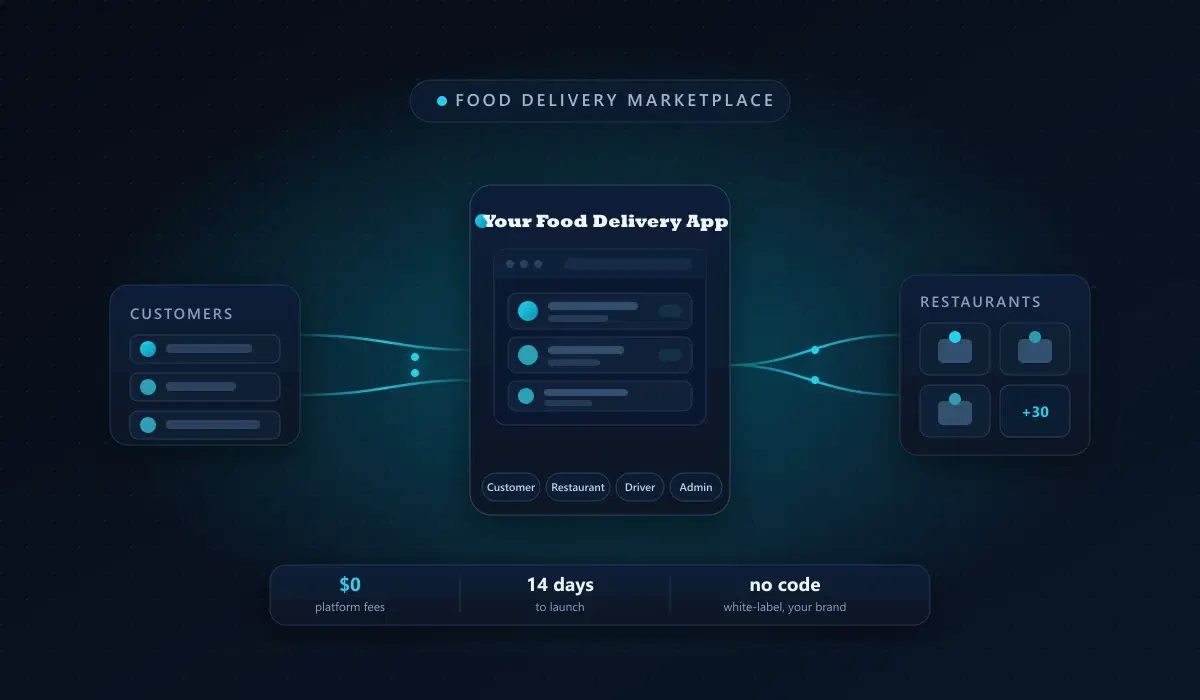
To build a food delivery marketplace you connect restaurants, customers, and delivery, and manage menus, orders, payments, and payouts in one system. You can build custom or configure a no-code platform like Nipige, which ships branded customer, vendor, driver, and admin apps and launches in about 14 days.
If you are researching how to build a food delivery marketplace, you have probably seen the two usual answers: pay a development company for a custom build, or wrestle a generic app builder into shape. There is a third route most guides skip, and for operators who want to run a marketplace rather than build software, it is usually the right one. This guide covers all three.
First, the part people underestimate: a food delivery marketplace is not one app. It is four, and the three you do not see as a customer are where most of the work lives.
What is a food delivery marketplace?
A food delivery marketplace is a branded platform where many restaurants list their menus and customers order from any of them in one app, while you, the owner, run the marketplace and set the commission or subscription. Think DoorDash or Uber Eats, except it carries your brand, and you keep the margin instead of paying it away.
Why build your own food delivery marketplace?
Two reasons: the market is enormous, and the aggregators are expensive to sell through.
The global online food delivery market reached roughly $1.4 trillion in 2025 and is projected to hit $1.51 trillion in 2026, according to Statista. At the same time, listing on an aggregator is costly: DoorDash's plans charge restaurants 15%, 25%, and 30% commission per order, and Uber Eats runs up to 30%, per Rezku's 2026 fee breakdown. Once processing fees and promotions are added, the effective cost restaurants pay often lands nearer 30–40% of each order.
Owning the marketplace flips that. You set the terms, you keep the customer relationship, and your restaurants stop handing a third of every order to a platform they do not control.
What are the parts of a food delivery marketplace?
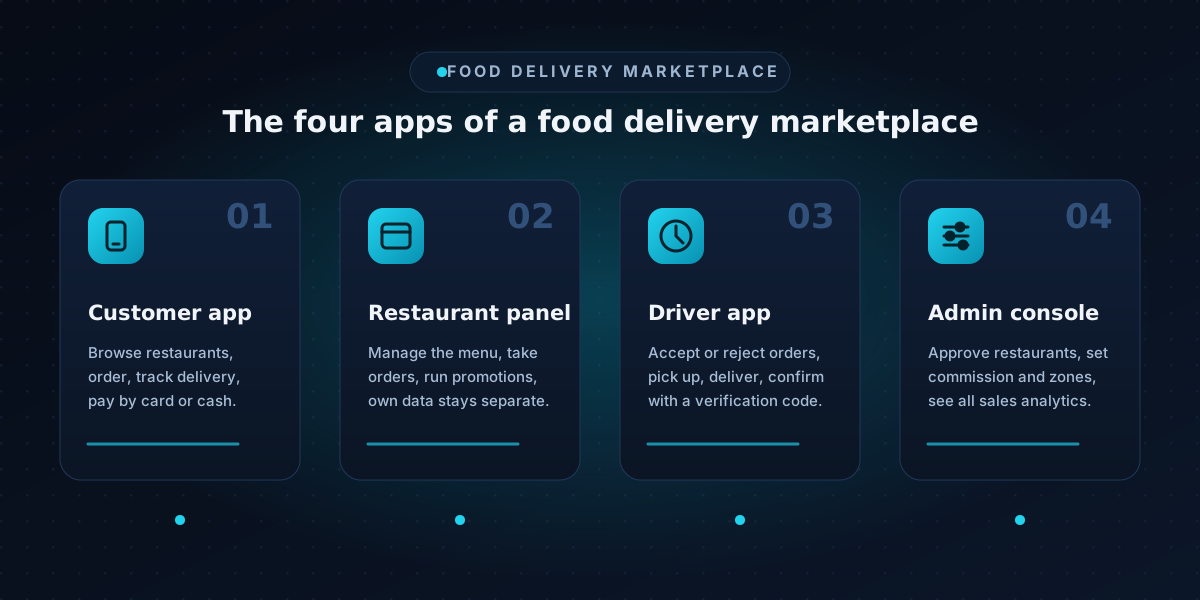
Every food delivery marketplace needs these four pieces working together, all under your brand:
- A customer app. Restaurant discovery and search, menu browsing with ratings and reviews, a cart with coupons and a full price breakdown, real-time order tracking, and card or cash payment.
- A restaurant panel. Each restaurant manages its own menu, takes orders, runs promotions, and sets its delivery preference, and its data stays separate.
- A driver app. Drivers go online, accept or reject orders, pick up, deliver, and confirm delivery with a secure verification code.
- An admin console. You approve restaurants, set commission and delivery zones, handle refunds, and see the whole marketplace with sales analytics.
The customer app is the visible part. The restaurant panel, the driver flow, and the admin controls are the majority of the build, and they are what a cheap quote tends to leave out.
How to build a food delivery marketplace, step by step
- Pick one city and a starting cuisine mix. Focused marketplaces reach liquidity faster. Start with one area and a handful of committed restaurants.
- Line up your first restaurants. Sign 5–15 restaurants who will actually take orders on day one. Supply first, always.
- Design the money flow. Decide your commission or flat subscription, who pays the delivery fee, and how restaurants get paid.
- Choose your build route (custom, generic builder, or no-code platform, compared below).
- Set up menus, zones, and delivery rules. Build each restaurant's menu, define delivery zones and per-distance pricing, and set your policies.
- Connect payments and launch in one zone. Go live with your committed restaurants and a small delivery area you can serve well.
- Grow restaurants and demand together. Add restaurants your customers ask for, and market to the customers your restaurants bring. Keep both sides growing.
What does it cost to build a food delivery marketplace?
It depends entirely on the route you choose.
| Route | Time to launch | Typical cost | You maintain | Best for |
|---|---|---|---|---|
| Custom build (dev agency) | 4–9 months | $30,000–$300,000+ | Everything: servers, updates, fixes | Genuinely unusual logistics |
| Generic app builder | Weeks to months | Lower upfront + your time | You: the stitched-together logic | Technical founders with time |
| No-code food platform (e.g. Nipige) | ~14 days | Flat monthly subscription | The platform (managed for you) | Owners who want to launch fast |
For the full custom-build numbers, see Cost to Build a Marketplace in 2026. To understand the revenue model before you set your own commission, How DoorDash Makes Money breaks it down.
The three ways to build one
1. Custom build with a development company
You get exactly what you spec, and a bill and timeline to match: typically $30,000 to $300,000+ over 4 to 9 months. You own the code, and every server, update, and change afterward. Right only when your marketplace genuinely needs something no platform offers.
2. A generic app builder
Tools like Bubble or a food-app script let you assemble something without a full dev team, but you still spend weeks wiring up menus, orders, delivery, and payments that were not purpose-built for food. You trade money for your own time.
3. A no-code food delivery platform
A purpose-built platform ships the four apps already connected and rebranded as yours. This is what Nipige does: a white-label, multi-restaurant food delivery marketplace you configure instead of code, with $0 platform transaction fees and a launch in about 14 days (from $899/month). You do not rebuild the plumbing; you run the marketplace.
Build an app like DoorDash, without DoorDash's commission
Most people who search "build an app like DoorDash" do not want to become DoorDash. They want DoorDash's experience under their own brand, in their own city, without paying a third of every order to someone else. That is exactly what your own marketplace gives you: the same four-app model, your brand, your customers, and a flat cost instead of a 30% cut.
Proof: platforms running at real scale
A template is only worth trusting if it holds real volume. FastForge, built on Nipige, runs 2,000+ orders per day. Teka, a hyperlocal commerce marketplace on the same platform, reports 1M+ shoppers and 15,000+ partner businesses. Different verticals, one platform, both operating at scale.
So which route is right for you?
- Genuinely custom logistics (your own routing, custom hardware)? Hire a development company and budget for it.
- Technical and time-rich? A generic builder can work.
- Want to launch a branded food marketplace in weeks, not spend six figures first? A no-code, white-label platform is the fastest path.
→ See how to launch a food delivery marketplace on Nipige
Planning more than one vertical? The same model applies to any marketplace: read How to Build a Multi-Vendor Marketplace. For groceries rather than restaurant meals the model is similar, but the catalog is far bigger. See how to build an app like Instacart.
Frequently asked questions
How do you build a food delivery marketplace?
You connect four apps: a customer ordering app, a restaurant panel, a driver app, and an admin console. You can build them custom, assemble them on a generic builder, or configure a no-code food delivery platform. A no-code platform like Nipige launches a branded, multi-restaurant marketplace in about 14 days without coding.
How much does it cost to build a food delivery marketplace?
A custom build usually costs $30,000 to $300,000+ over 4 to 9 months. A no-code food delivery platform is a flat monthly subscription instead (from $899/month), with $0 platform transaction fees, so you launch for far less upfront.
How long does it take to launch a food delivery marketplace?
A custom build takes 4 to 9 months. On a no-code platform like Nipige, a branded, multi-restaurant food delivery marketplace can go live in about 14 days.
Can I build a food delivery app without coding?
Yes. A no-code food delivery platform lets you configure restaurants, menus, delivery zones, and branding instead of writing code. The customer app, restaurant panel, driver app, and admin console are already built.
How is my own marketplace better than listing on DoorDash?
On DoorDash or Uber Eats you pay 15–30% per order and never own the customer. Your own marketplace carries your brand, keeps the customer relationship, and replaces that commission with a flat monthly cost.
The Next Step
Nipige's Restaurant template ships the customer app, restaurant panel, driver app, and admin console already connected and rebranded as yours — from $899/month with $0 platform transaction fees, live in about 14 days.
Book a 20-minute walkthrough → See the ordering, dispatch, and payout flow configured against your own city and cuisine mix.
The Nipige team builds and operates production marketplace infrastructure - vendor onboarding, real-time dispatch, payments, and native apps - drawing on 13+ years of enterprise billing and monetization engineering at Trigital Technologies.