Cost to Build a Marketplace in 2026: What It Actually Costs
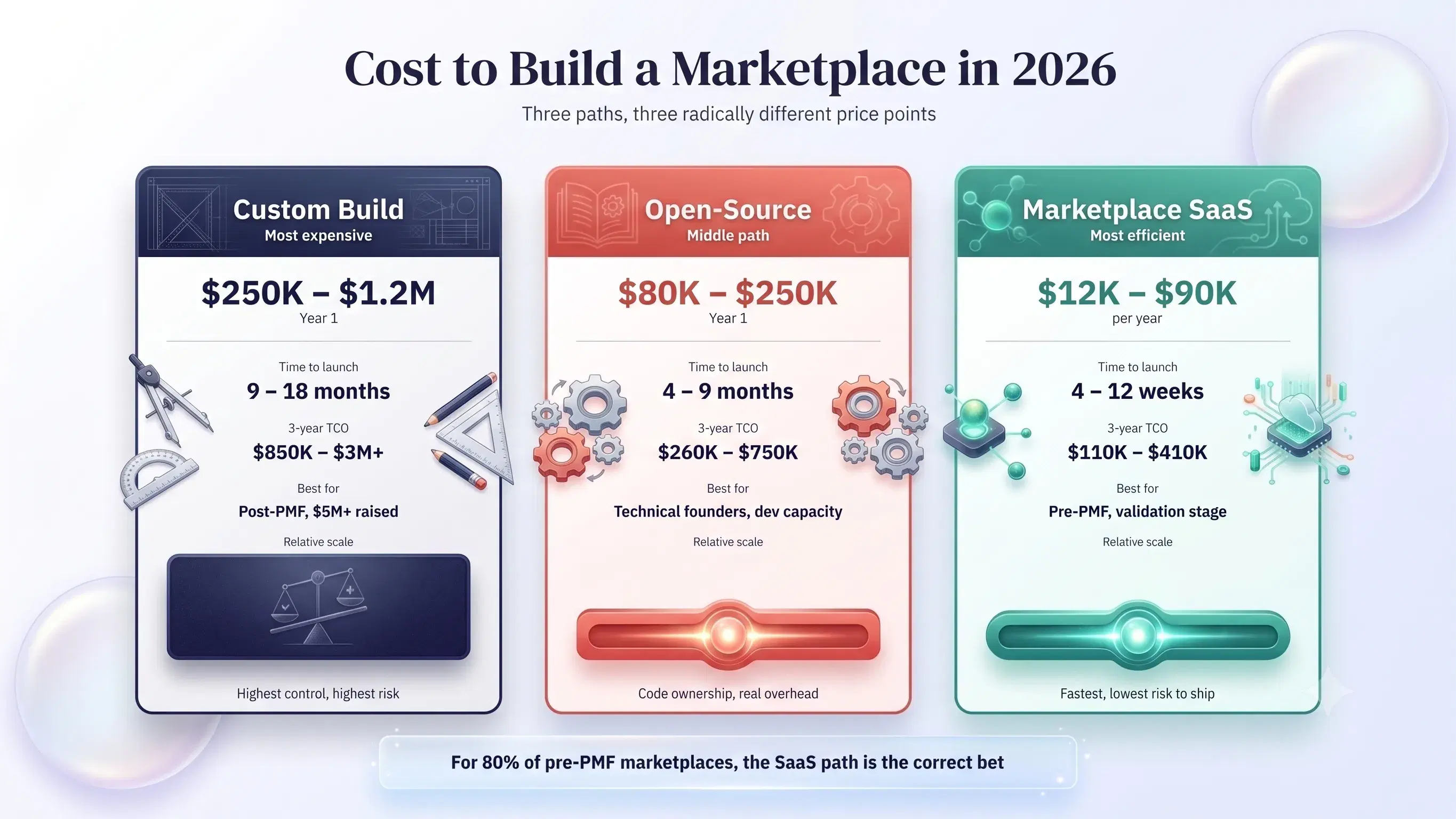
What it costs to build a marketplace depends almost entirely on which of three routes you take, and how much of the marketplace you need to build rather than configure. This guide covers what drives cost inside each route, the line items founders forget until Year 2, and how to model your own number instead of trusting someone else's.
If you've searched "cost to build a marketplace," you've probably seen the same useless answer five times in a row: "It depends — anywhere from $20K to $500K." That's not a budget. That's a shrug with a price range.
Here is the more honest version: there is no public dataset that prices marketplace builds. Any article quoting a precise industry range, including ranges this article used to quote, is extrapolating from a handful of projects. What you can do is understand the cost drivers well enough to price your own build, and get real quotes against a real spec. That is what the rest of this guide is for.
TL;DR — The Three Cost Paths at a Glance
| Path | Cost shape | Typical time to launch | Best for |
|---|---|---|---|
| Custom development | A project cost: engineering salaries or agency fees, then permanent maintenance | Many months, often a year or more | Post-PMF, funded, with a model no platform supports |
| Open-source / clone scripts | A small licence cost plus a large, open-ended customization cost | Several months | Technical founders with in-house dev capacity |
| Marketplace SaaS platform | A published subscription, plus setup and anything outside the platform | Weeks | Validation stage, most pre-PMF marketplaces |
Timelines above are typical, not measured. The cost column is deliberately qualitative: the number that matters is the one you get from pricing your own spec, and the sections below tell you what to price.
For how subscription platforms themselves are priced, and how to compare quotes that are structured differently, see what marketplace software costs.
Path 1: Custom Development
This is what most founders mean when they say "build a marketplace." Hire a team, write code from scratch, own the IP.
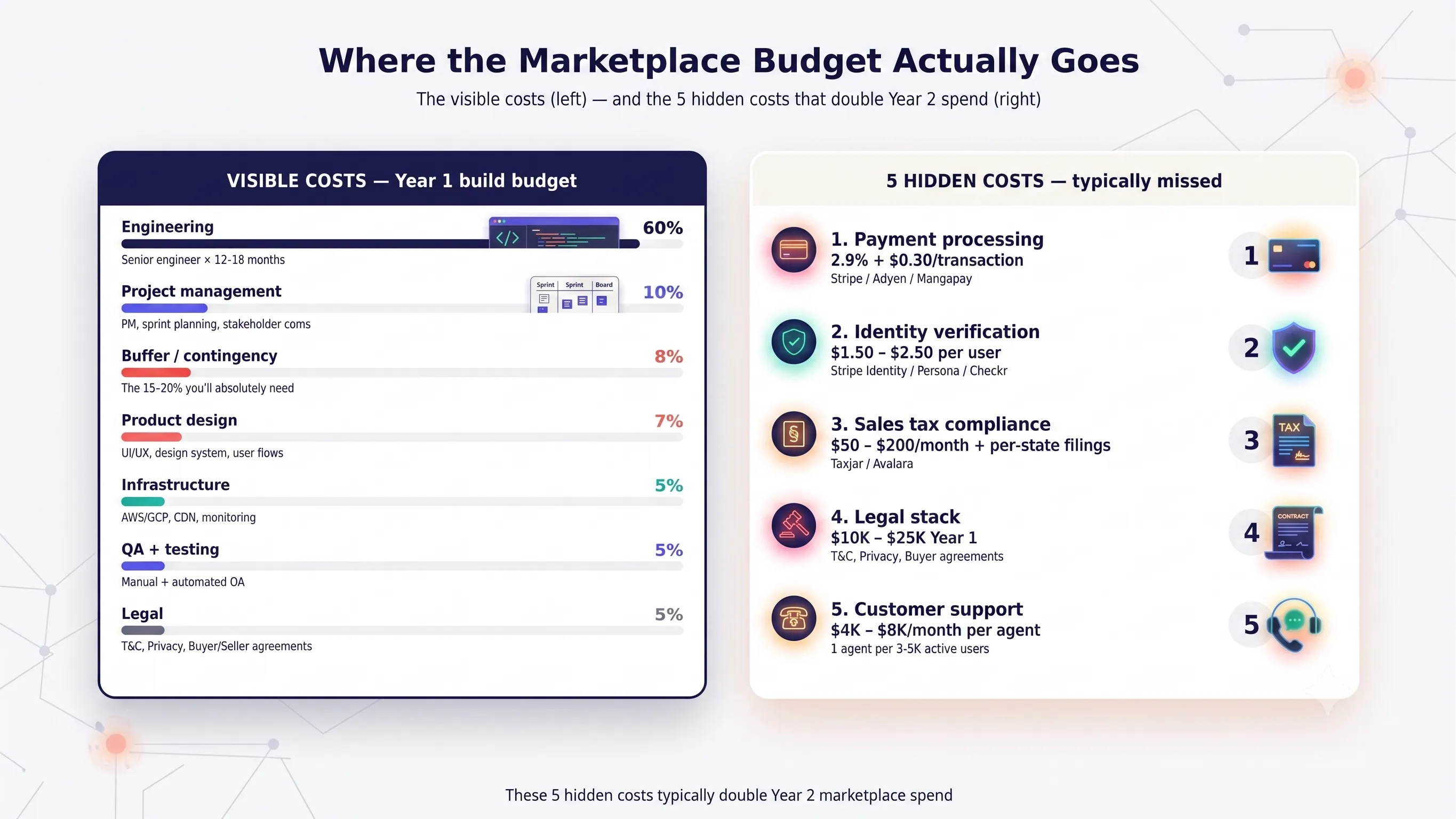
What you are actually paying for. Price each of these at your own local rates and you will have a real number rather than a borrowed one:
| Line item | What it buys | How to price it |
|---|---|---|
| Senior engineering time | The build itself, over many months | Engineer-months × your blended rate |
| Product design | UI/UX, design system, user flows | Hours × designer rate |
| Project management | Sprint planning, coordination, stakeholder comms | Hours, or a percentage of engineering |
| QA | Manual and automated testing | Hours × QA rate |
| Cloud infrastructure | Hosting, CDN, monitoring, error tracking | Provider list pricing at your expected load |
| Third-party integrations | Payment processor setup, identity verification, email | Setup effort plus metered vendor fees |
| Legal | Marketplace-specific terms, privacy, buyer/seller agreements | Lawyer-drafted, not templates |
| Contingency | The overrun you will have | A fixed percentage of the total |
The single biggest driver is the first row, and the honest way to estimate it is in engineer-months rather than dollars, because rates vary several-fold by geography.
Why marketplaces specifically are expensive to build custom: marketplace primitives — payments with escrow and split payouts, two-way identity verification, dispute resolution workflows, two-sided search, review systems with hold periods, vendor onboarding — are a substantial block of engineering work in their own right, and none of them are visible to your customers as "value." They're table-stakes infrastructure that must work before anyone trusts your platform. Cost scales with how much of your booking, pricing, and dispatch logic is genuinely unlike anything a platform already does.
When custom makes sense: post-PMF, funded, with validated demand in your vertical, and you've hit the customization ceiling of a platform. Before all four of those are true, you're spending money to learn lessons you could have learned faster on a SaaS platform.
For a deeper look at the build-vs-buy decision specifically for vacation rental marketplaces, see our How to Build a Marketplace Like Airbnb guide — the same trade-offs apply across most verticals.
Path 2: Open-Source / Clone Scripts
There's a middle path: take an existing open-source codebase or clone script and customize it.
Legitimate open-source frameworks
- Sharetribe Web Template — free, React-based, runs on top of the Sharetribe API (available on the Extend plan)
- Cocorico — open-source PHP marketplace framework (less actively maintained but functional)
- Vendure — open-source headless commerce, marketplace-extendable
- Forked WordPress + WooCommerce + multi-vendor plugins — common but problematic at scale
What "clone scripts" actually are
A market segment sells "Airbnb clone scripts," "Uber clone scripts," "Fiverr clone scripts" at a fraction of a custom build's price. Some are legitimate forked open-source codebases with reasonable architecture; most are PHP-on-Rails-on-jQuery from 2018 that will collapse the moment you try to extend them in any direction that matters.
If you're considering a clone script: demand the codebase before payment, hire a senior engineer to audit it for two days, and budget the customization work as if you're starting from scratch (you basically are).
What actually costs money on this path
The licence is the small part. Price these instead:
- Licence or script purchase — the only genuinely cheap line
- Senior developer customization — months of work, and the dominant cost
- DevOps and self-hosting — you own the infrastructure now
- Security audit — non-negotiable on inherited code you didn't write
- Ongoing maintenance — dependency upgrades, patches, breakages, every year
A low sticker price on a licence or a free template is misleading in the same way a free puppy is. The customization and the years of maintenance are the cost, and both are open-ended.
When this path makes sense: you have an in-house dev team, you need on-premise hosting for compliance reasons, and you value code ownership over launch speed.
Path 3: Marketplace SaaS Platforms
This is the route most validation-stage marketplaces now take. The platform handles marketplace primitives — listings, search, payments, reviews, messaging, vendor onboarding — and you focus on what's actually defensible: vertical depth, supply acquisition, and brand.
How the SaaS landscape is priced
Subscription platforms publish their pricing, which makes this the one path you can price precisely before committing. The shape of the market:
| Tier | Examples | What you get |
|---|---|---|
| Entry | Sharetribe (Lite to Extend), Bubble with a marketplace template, Arcadier Starter | Templated marketplace, basic customization, all primitives |
| Mid-market | Arcadier Pro, purpose-built vertical platforms | Custom domains, deeper customization, vendor onboarding workflows |
| Enterprise | Marketplacer, Mirakl | Multi-tenant, SSO, custom SLAs, dedicated CSM — quoted, not listed |
As verified examples of how those tiers are actually priced: Sharetribe publishes a Build plan at $39 a month, then Lite at $99, Pro at $199 and Extend at $299 a month billed yearly, each including a monthly transaction allowance with additional transactions charged beyond it. Bubble publishes Starter at $59, Growth at $209 and Team at $549 a month billed annually, metered in workload units rather than transactions (both verified 29 September 2026). Enterprise platforms generally do not publish numbers at all.
Nipige sits across the entry and mid-market bands rather than at the top: its plans are priced per vertical. See Nipige pricing for current figures (verified 29 September 2026).
What's actually included
- Hosted infrastructure — no DevOps required
- Payment integration — Stripe Connect, Adyen, or Mangopay pre-configured with marketplace split payouts
- Vendor onboarding — configurable workflows, document upload, verification
- Reviews and trust — two-way reviews, hold periods, flagging
- Search and filters — geographic, attribute-based, faceted
- Messaging — in-platform chat between buyers/sellers/providers
- Admin dashboard — moderation, analytics, dispute management
- Support — varying tiers; mid-market typically includes a CSM
What's NOT included (and you'll still need to budget)
- Heavy custom development beyond the platform's extension points
- Marketing, SEO, and paid acquisition
- Customer support team (you'll need to hire your own)
- Transaction charges beyond your tier's included allowance, where the platform meters them
- Migration costs if you outgrow the platform
When this path makes sense: validation-stage and early-PMF marketplaces, agencies building for clients, and any founder who wants to spend Year 1 acquiring supply rather than building software.
The two questions to ask any marketplace platform before signing:
- Can I customize booking/pricing logic without leaving the platform? Many platforms cap you at hourly/nightly pricing. If you need tiered pricing (Airbnb-style nightly + cleaning + service fee), confirm it works out of the box.
- Who owns the merchant-of-record relationship? This determines your sales-tax exposure and is non-negotiable to clarify before launch.
For a deeper comparison of the leading marketplace SaaS platforms — pricing, customization ceilings, and vertical fit — see our Sharetribe alternative comparison. If you're specifically building a service marketplace (home services, professional services, B2B services), the service marketplace software guide breaks down platform fit by vertical.
The Hidden Costs Everyone Misses (And Will Bite You in Year 2)
These five line items show up in roughly zero "cost to build a marketplace" articles. They appear in essentially every real marketplace P&L.
1. Payment processing
Stripe Connect — the de facto marketplace payment standard — charges a percentage of every transaction, sometimes plus a fixed fee, and Connect adds platform-side charges such as per-active-account and per-payout fees depending on how you configure pricing. Rates vary by country, payment method, and where the card was issued, so check Stripe's published Connect pricing for your own market.
The point founders miss is which number the fee applies to. Processing is charged on the full transaction value, while your revenue is only your take rate. Model it that way: if you take 15% of each sale and your processor takes roughly 3% of the whole sale, payments consume around a fifth of your revenue before you have paid for anything else. Substitute your own processor's published rate — the 3% here is an illustration, not a quoted rate — and the ratio still holds.
Adyen for Platforms and Mangopay are alternatives, particularly for European or multi-currency setups, with similar but configurable rate structures. For how the money actually splits and settles, see how marketplace payments work.
2. Identity verification and trust infrastructure
For peer-to-peer marketplaces, identity verification is not optional, and it is priced per check rather than per month. Stripe Identity, Persona, and Checkr are the common choices, with background checks costing substantially more per person than a basic ID verification. Take each provider's current published per-verification price, multiply by your expected new users per month, and you'll find it is a real recurring line rather than a rounding error.
3. Sales tax compliance (the US tax nightmare)
If you're operating a marketplace in the US and have economic nexus in multiple states (almost certain at any meaningful volume), you're responsible for collecting and remitting sales tax. Doing this manually is approximately impossible. TaxJar and Avalara are the tools founders use, both priced on a subscription plus transaction volume, and both sitting on top of accountant fees to actually file returns in every state where you have nexus.
4. The legal stack you can't fake
Marketplaces have unique legal complexity: you're an intermediary between two parties whose disputes can land on you. The minimum legal stack is a marketplace-specific Terms of Service, a privacy policy that satisfies GDPR and CCPA, cookie consent management, buyer and seller agreements, and a DMCA and content-moderation policy. Lawyer-drafted, these are a meaningful one-off cost; a Lorem-Ipsum legal page is a hard conversion killer and a manual-action risk with Google. Don't.
5. Customer support (the cost that scales linearly)
Marketplaces require human dispute resolution. Two parties, one transaction, one of them is unhappy — that's a CX ticket every time. Support headcount scales roughly with active users rather than revenue, which is what makes it dangerous: it is the one cost that does not benefit from software leverage. Price it as agents (at your local fully-loaded cost) plus per-seat tooling, and revisit the number at every growth stage.
Cost by Marketplace Vertical
Not all marketplaces cost the same to build. The vertical and operating model materially change the spec, and therefore the price of Path 1 and Path 2. Rather than quote per-vertical figures we cannot evidence, here is what actually drives the difference:
| Vertical | What drives the cost |
|---|---|
| Rental marketplace (Airbnb-like) | Booking calendar, escrow, reviews — moderate complexity |
| On-demand services (Uber-like) | Real-time dispatch, GPS, driver/provider tooling — the most expensive category |
| E-commerce marketplace (Etsy-like) | Inventory, shipping, multi-currency — moderate complexity |
| Service marketplace (TaskRabbit-like) | Provider verification, scheduling, and a dispatch hybrid |
| B2B marketplace (Faire-like) | Bulk pricing, invoicing, credit terms, approval workflows — complex |
| Aggregator marketplace | Multi-vendor, multi-tier commissions, supplier integrations |
Use this to work out where your build sits relative to a simpler one, then price that difference with your own quotes. The on-demand vertical is uniquely expensive because of real-time dispatch logic — see our DoorDash revenue model breakdown for why this category requires materially more infrastructure than booking-based marketplaces.
How to Model Your Own 3-Year TCO
Year 1 is the cheapest year, and it is the only one most founders budget for. Rather than publish three-year totals we cannot substantiate, here is the model to build for yourself — the same one an investor will ask you to show.
Year 1 = build or subscription + setup and implementation + integrations + legal + infrastructure + the launch content nobody budgets for.
Year 2 = everything that recurs, plus the two that grow: engineering (on a custom build, this never stops) and support headcount (which scales with active users, not revenue). On a subscription platform, Year 2 is mostly your plan tier plus whatever you have outgrown.
Year 3 = Year 2, plus the cost of whatever expansion you are planning — a second vertical, a second country, or the migration off a platform you have outgrown.
Two structural points hold regardless of your numbers. On a custom build the largest three-year line is rarely the original build: it is the engineering team you keep employed afterwards. And on a subscription platform the three-year total is dominated by whether the platform meters your growth — a percentage of GMV or a per-transaction charge compounds in a way a flat subscription does not.
The Build-vs-Buy Decision Framework
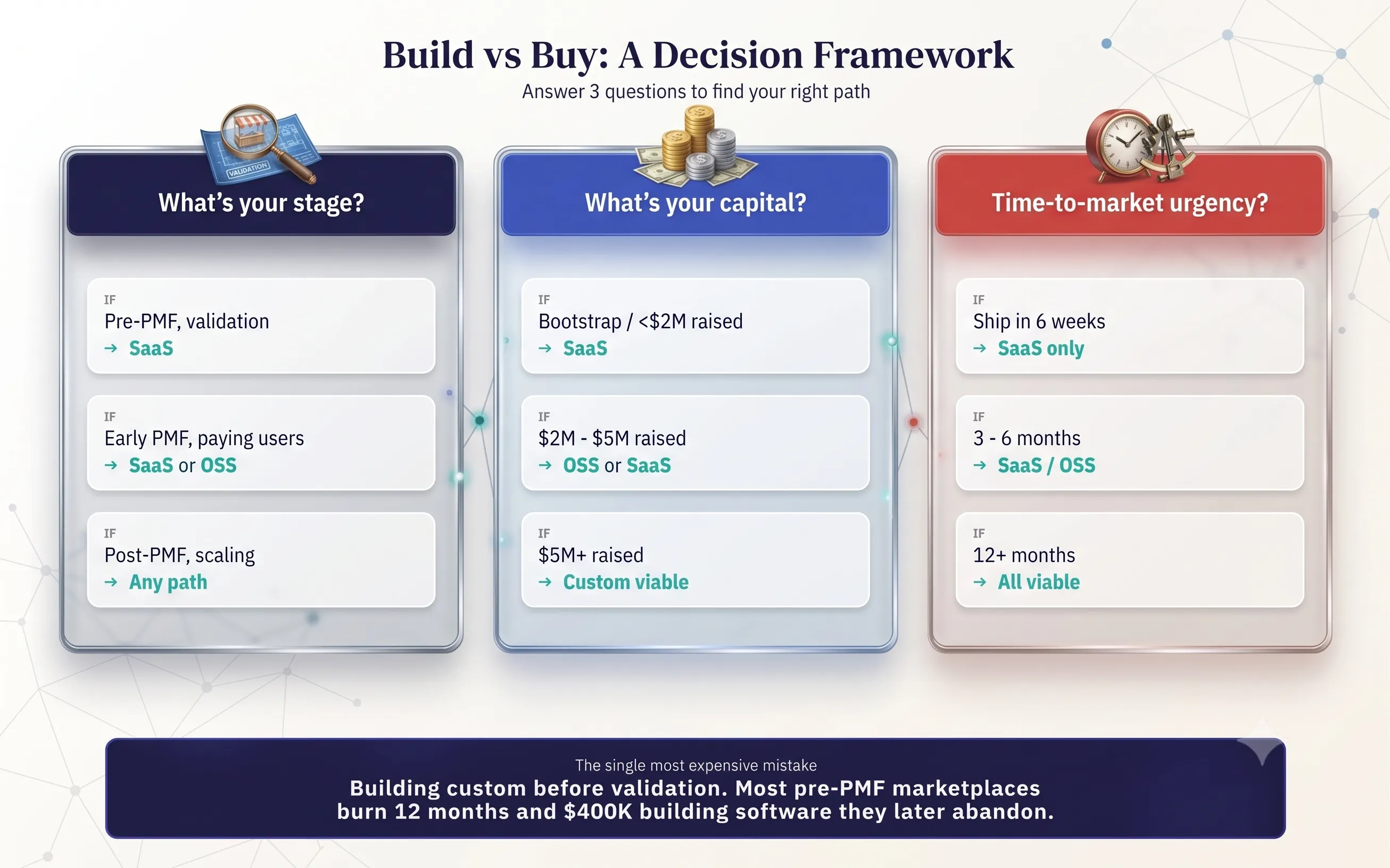
Five questions, in order. Don't move to step N+1 until you've answered N.
1. What's your validation stage?
Pre-PMF or unvalidated? → SaaS. Period. Use the savings on supply acquisition and customer research, which are where wins actually come from.
Post-PMF with paying users and a clear thesis? → Build-vs-buy becomes a real conversation.
2. What's your capital position?
Bootstrapped or lightly funded? → SaaS. The runway math doesn't work otherwise.
Funded, with a defined runway to your next raise? → An open-source or SaaS hybrid. Spend cash on customer acquisition, not infrastructure.
Well funded post-PMF, with clear runway? → A custom build becomes financially viable.
3. What's your engineering capacity?
No technical co-founder? → SaaS. You'll spend the next 6 months trying to manage engineers you don't understand.
One technical co-founder, no team? → SaaS or open-source. Don't try to build marketplace primitives solo.
Full engineering team in-house? → All three paths are viable.
4. What's your time-to-market sensitivity?
Need to ship in weeks? → SaaS. No other path delivers in this timeline.
A few months? → SaaS or aggressive open-source.
A year or more, and willing to fund the build? → Custom is possible.
5. What's your defensibility thesis?
Defensibility from vertical depth, supply quality, brand? → SaaS. Software isn't your moat.
Defensibility from proprietary tech (AI matching, dispatch algorithms, network effects in the code itself)? → Custom build is justified.
For a shorter gut-check on whether to build or buy in the first place, see build vs buy a marketplace.
What Separates the Founders Who Ship
The pattern worth internalising is about sequencing, not spend. Founders who start on a platform put their first version in front of real users while the question is still cheap to answer, and they learn whether anyone wants the marketplace before they have committed to a codebase. Founders who start with a custom build commit their capital and their calendar before that question is answered, and frequently spend the first year building software rather than recruiting supply.
That is the real cost comparison. Not the invoice — the months.
Frequently Asked Questions
How long does it actually take to build a marketplace?
On a done-for-you marketplace platform, weeks: Nipige's own setup runs about 14 days. A custom build is a multi-month project, often a year or more before a marketplace is genuinely production-ready. The software is rarely the bottleneck; supply acquisition and the first 100 users are.
Is a no-code marketplace platform better than custom development for launching fast?
For validation-stage founders, yes. A no-code platform is a subscription you can start this month, while a custom build is a multi-month project with an engineering team behind it. Custom development pays off after product-market fit, when you need booking or pricing logic no platform supports.
What's the cheapest way to build a marketplace?
Entry plans on an established no-code or marketplace platform, plus a template and some freelancer time. Sharetribe's live plans start at $99 a month billed yearly (verified September 2026). Expect throwaway quality at that level: if you find traction, plan to rebuild on something that can carry real volume.
Can I build a marketplace for under $10K?
For an MVP prototype to test demand, yes, on entry-tier no-code plans. For a marketplace that handles real transactions with real users, and that you can defend operationally when something goes wrong, no.
Should I hire offshore developers?
Offshore engineering can reduce build cost materially against US rates, and the trade-offs are real: communication overhead, time-zone friction, and wide variance in code quality. If you go offshore, hire one senior engineering lead in your own timezone to own quality and review.
What about no-code platforms like Bubble?
Bubble is genuinely useful for validation prototypes. Performance ceilings are real once you cross modest transaction volume, and its usage-based pricing is hard to forecast before you build. Use it explicitly for throwaway prototypes; don't plan to scale on it.
How much do marketplace SaaS platforms cost vs custom?
Marketplace SaaS is a published subscription you can check on a vendor's own pricing page. Custom development is a project quote, and it can require substantially more upfront investment, because you are funding product design, engineering, QA, infrastructure and implementation rather than subscribing to a product that already exists. For most pre-PMF marketplaces, that money is better spent on supply acquisition than on software.
Does Nipige fit a $50K Year 1 budget?
Yes. Nipige's entry and growth tiers are a flat monthly subscription, which at current pricing is roughly $8.4K to $20K a year depending on vertical and tier, leaving the rest of a $50K Year 1 budget for customization, design, and supply acquisition. See the pricing page for current figures.
The Next Step
The right marketplace cost path is the one that matches your stage, capital position, engineering capacity, and timeline — not the one with the most attractive sticker price. For most pre-PMF marketplaces that path is SaaS; open-source with significant customization suits a smaller group of technical teams; and custom development becomes the right answer post-PMF, with clear capital behind it.
If you're at the decision point, Nipige is built for the SaaS path at the mid-market level: flat-rate pricing with no per-transaction take that punishes your growth, and vendor onboarding as a first-class primitive. See Nipige pricing for the exact tiers.
The Nipige team builds and operates production marketplace infrastructure - vendor onboarding, real-time dispatch, payments, and native apps - drawing on 13+ years of enterprise billing and monetization engineering at Trigital Technologies.