How to Scale a Marketplace (2026): Liquidity, Balance, and Growth
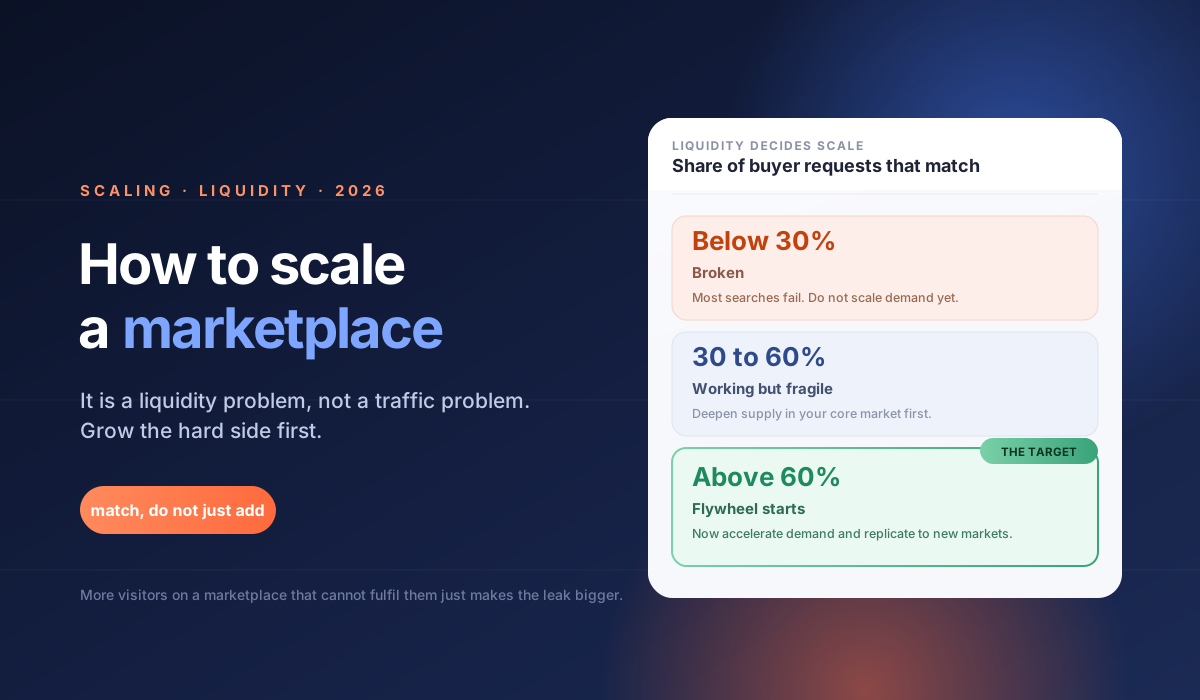
Scaling a marketplace is not a traffic problem, it is a liquidity problem. The ones that grow are the ones where buyers reliably find what they came for and sellers reliably get business. This guide covers the one number that decides whether you can scale, which side to grow first, how to keep the two sides in balance, and the mistake that stalls most marketplaces.
How do you scale a marketplace?
You scale a marketplace by raising liquidity, not traffic. Grow the harder side first, usually supply, until buyers find a match most of the time, then pour on demand. Keep the two sides in balance as you go, because one side almost always costs more to acquire or churns faster than the other. And expand one market at a time rather than everywhere at once, so your supply and demand stay dense enough to actually transact. More visitors on a marketplace that cannot fulfil them just makes the leak bigger.
Liquidity is the number that matters
Liquidity is the share of buyer requests that find a successful match. It is the single best measure of marketplace health, and it decides whether growth compounds or leaks away. Below about 30 percent, the experience is broken: most buyers leave empty-handed and do not come back. Above about 60 percent, the flywheel starts: buyers tell other buyers, sellers see real business, and each side pulls the other in. Watch the signals underneath it too, the search-to-match rate, response time, and how many usable results a search returns. If those are weak, adding traffic will not fix it.
| Liquidity | What it means | What to do |
|---|---|---|
| Below 30% | Broken, most searches fail | Do not scale demand yet, fix supply and matching |
| 30 to 60% | Working but fragile | Deepen supply in your core market before expanding |
| Above 60% | Flywheel starts | Accelerate demand and replicate to new markets |
Grow the hard side first
The two sides of a marketplace are rarely equal. One is harder to get, and it is usually supply: the sellers, providers, or listings. For the first 6 to 18 months, treat growth as lopsided on purpose. Concentrate on that hard side until it is deep enough to serve demand, then accelerate the easier side. You win supply the hard way at first, through direct outreach, partnerships, and hands-on onboarding, while demand comes later through paid, SEO, and content. Turning on demand marketing before supply is liquid just spends money sending buyers to empty results.
Keep the two sides in balance
Even once both sides are growing, they drift. One side costs more to acquire, churns faster, or converts slowly, so scaling means constant small corrections. The levers are straightforward.
| When this happens | The lever |
|---|---|
| Not enough demand | Subsidize buyers, invest in demand marketing, improve conversion |
| Not enough supply | Offer seller incentives, ease onboarding, guarantee early business |
| New sellers get no traffic | Boost new providers in search and ranking |
| Prices swing too much | Use dynamic or guided pricing to stabilize |
The goal is not to grow both sides as fast as possible. It is to keep them matched. A marketplace that is 10 times bigger but out of balance is a worse experience than a small one that clears.
Expand one market at a time
Scaling by geography or category is where liquidity most often breaks. Spread too thin and you turn one liquid market into ten empty ones. The playbook that worked for Airbnb, Uber, DoorDash, and Faire was the opposite: pick a narrow beachhead, seed the hard side by hand, reach real liquidity in that one segment, then replicate the exact motion market by market. Each new market is its own cold start, so do not assume national demand until a single city works.
The mistake that stalls marketplaces
The common failure is scaling vanity numbers, visits and gross merchandise value, while liquidity stays broken. Marketplaces rarely die of a product flaw. They die of sequencing and balance: growing both sides at once and never reaching the density where matches happen. What actually breaks at scale is usually operations, trust, and payments, not demand. If a search still fails half the time, the answer is a deeper core market, not a bigger ad budget.
Where Nipige fits
As you scale, two things get heavier: the infrastructure and the fees. Nipige is a managed, no-code platform, so the hosting, apps, and updates scale with you and you spend your time on liquidity instead of servers. It ships a customer app, a vendor app, an admin console, and native iOS and Android apps, so both sides have a real product as volume grows. And because Nipige charges $0 platform transaction fees, your economics get better as you scale, not worse. On a platform that takes a percentage of every sale, that cut grows with your GMV. On Nipige it stays $0, and you keep 100 percent.
If you are still at the launch stage, start with how to start an online marketplace. To set the take rate your scaling economics depend on, read marketplace business models explained. See the pricing or book a demo.

Frequently Asked Questions
What does it mean to scale a marketplace?
Scaling a marketplace means growing volume while keeping both sides matched, not just adding traffic. The real measure is liquidity, the share of buyer requests that find a seller. Growth that outruns liquidity leaks away, because buyers who do not find a match do not return.
What is marketplace liquidity?
Liquidity is the percentage of buyer requests that find a successful match. Below about 30 percent the marketplace feels broken, and above about 60 percent the flywheel starts, where each side pulls the other in. It is the single most important number to track as you grow.
Which side of a marketplace should you grow first?
Grow the harder side first, which is usually supply: the sellers, providers, or listings. Concentrate on it for the first 6 to 18 months until buyers can find a match most of the time, then accelerate demand. Turning on demand before supply is liquid sends buyers to empty results.
Why do marketplaces fail to scale?
Most fail on sequencing and balance, not on product. Founders grow both sides at once and never reach the density where matches happen, or they scale traffic and gross merchandise value while liquidity stays broken. What breaks at scale is usually operations, trust, and payments, not a lack of demand.
How do you scale a marketplace to new markets?
Expand one market at a time. Pick a narrow beachhead, seed the hard side by hand, reach real liquidity in that segment, then replicate the same motion market by market. Each new city or category is its own cold start, so do not assume demand until one market clears.
The Nipige team builds and operates production marketplace infrastructure - vendor onboarding, real-time dispatch, payments, and native apps - drawing on 13+ years of enterprise billing and monetization engineering at Trigital Technologies.