How Much Does Marketplace Software Cost? (2026)
There is no single price for marketplace software. Subscription platforms charge a monthly fee that varies by vertical, vendor count and transaction volume, while custom development replaces that fee with a large upfront project cost. The headline subscription is rarely the total: setup, payment processing, mobile apps, integrations, customization and support are usually separate. Compare the full total at the volume you actually expect, not the entry price.
Marketplace software is quoted in at least four different ways, which is why two platforms can look a thousand dollars apart on their pricing pages and end up costing the same at your volume. This guide explains what actually drives the price, which costs sit outside the subscription line, and how to compare proposals that are not structured alike.
What determines marketplace software cost?
Six things move the number more than anything else:
- Build approach. Configuring an existing platform, extending a no-code builder, or commissioning a custom build are different orders of magnitude, not different discounts.
- Marketplace complexity. A directory with listings is cheaper to run than a marketplace with real-time dispatch, scheduling, escrow, or multi-currency payouts.
- Transaction volume. Many platforms price against orders, initiated transactions, or server usage, so volume changes the bill even on a fixed plan.
- Vendor count. Supply-side seats and vendor limits are a common tier boundary.
- Mobile apps. Native iOS and Android apps are frequently a higher tier or a separate build, not a default inclusion.
- Payments, integrations, and customization. Payouts, ERP or CRM connections, and anything outside a platform's extension points are usually priced separately.
Notice that only one of those is a property of the software. The rest are properties of your marketplace, which is why a single industry price does not exist.
SaaS marketplace software costs
Most marketplace SaaS is a monthly subscription with capability tiers, but the pricing model underneath differs, and that is what you are really choosing between.
Subscription plus a transaction allowance. Sharetribe publishes a Build plan at $39 per month, then Lite at $99, Pro at $199, and Extend at $299 per month billed yearly. Each live plan includes a monthly allowance of initiated transactions — 50, 250, and 500 respectively — with additional transactions charged at $0.19 or less each. Sharetribe states it takes no commission on your sales, but the allowance means the effective monthly cost still moves with volume (verified 29 September 2026).
Percentage of sales. Some platforms take a cut of every transaction on top of the subscription. This is the model that changes your economics most as you grow, because the fee scales with gross merchandise value while the value delivered stays roughly constant.
Quote-based enterprise. Above a certain complexity, most vendors stop publishing numbers. Multi-tenant deployments, SSO, custom SLAs, and procurement requirements are quoted, not listed.
When comparing these, convert each to the same unit: total platform cost per month at your expected transaction count.
No-code and configurable platform costs
General-purpose no-code builders price differently again, usually against usage rather than transactions. Bubble publishes a free development tier, then Starter at $59 per month, Growth at $209, and Team at $549, each billed annually, with Enterprise quoted on request. Each plan includes a monthly allowance of "workload units", Bubble's measure of the server resources an app consumes, and apps that exceed their allowance either buy additional capacity or pay overages. The per-unit overage price is not published on the pricing page (verified 29 September 2026).
That is worth understanding before choosing this route: with usage-based pricing, your bill is a function of how efficiently your app is built, which is difficult to forecast before you build it.
Purpose-built marketplace platforms sit between the two — configurable like a builder, but priced against marketplace units like vendors and orders rather than raw compute.
Custom marketplace development costs
Custom development replaces a subscription with a project cost plus permanent ownership of the maintenance. You are buying control: any model, any workflow, no platform ceiling. You are also taking on hosting, security patching, app-store releases, and an engineering team to keep it running after launch.
The trade-off only pays off when your marketplace genuinely needs something no platform supports, and you can fund the build and its ongoing engineering. For the full build-cost analysis by path and vertical, see the cost to build a marketplace; if you are still weighing the two routes, build vs buy a marketplace works through the decision.
What the subscription price doesn't include
This is where quotes diverge most. Check each line explicitly:
| Cost | Who charges it | Usually separate? |
|---|---|---|
| Setup and implementation | Platform or agency | Often, and sometimes one-off |
| Payment processing | Your payment processor | Always separate |
| Platform transaction fee | The software vendor | Depends entirely on the vendor |
| Native mobile apps | Platform tier or a build | Frequently a higher tier |
| Integrations | Platform, vendor, or agency | Usually |
| Customization | Platform or agency | Beyond extension points, yes |
| Hosting and infrastructure | Platform, or you | Included on managed platforms |
| Maintenance and updates | Platform, or your team | Included on managed platforms |
| Support | Platform, by tier | Tier-dependent response times |
| Third-party services | SMS, maps, email providers | Almost always metered separately |
Payment processing deserves its own line. It is charged by your processor — not by your marketplace software — and it applies no matter which platform you pick. Stripe's Connect pricing shows a percentage of each transaction that varies by country and by where the card was issued, plus optional platform-side charges such as a per-monthly-active-account fee and per-payout fees, depending on whether the platform or Stripe sets the pricing (Stripe publishes region-specific rates, so check the page for your own country; verified 29 September 2026). For how the money actually moves and splits, see how marketplace payments work.
How to compare marketplace pricing
Use this as a buyer decision framework, not an accounting standard or an industry formula. It exists to make structurally different quotes comparable:
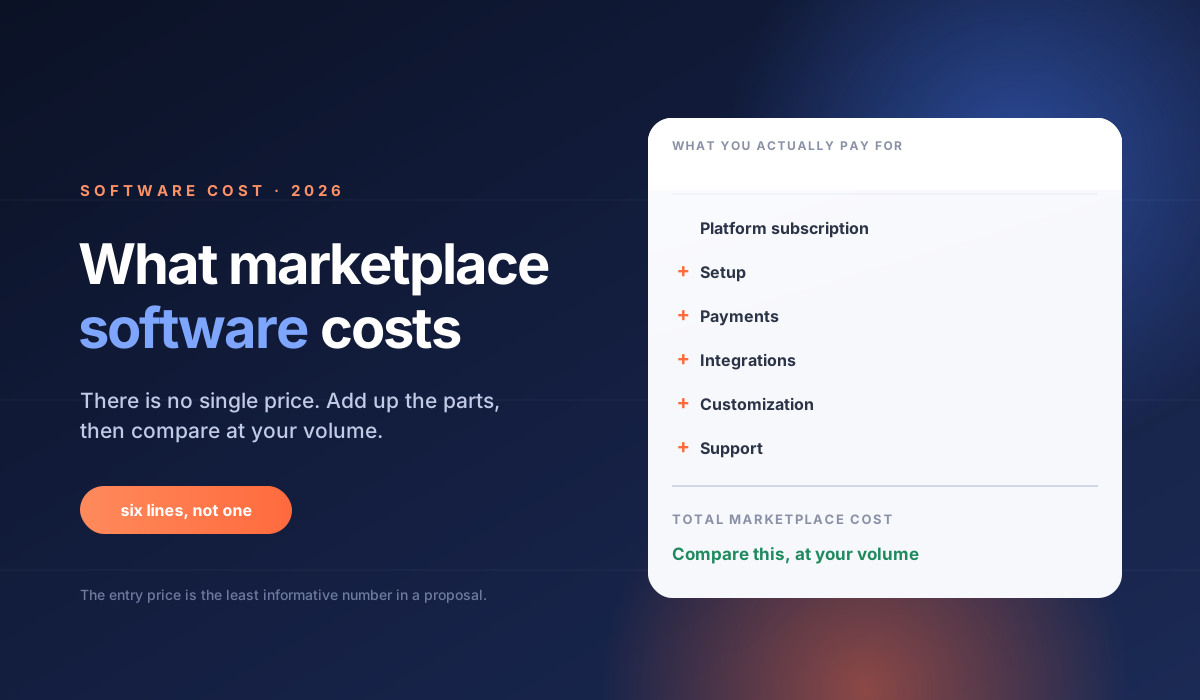
Total marketplace cost =
    platform subscription
  + setup / implementation
  + transaction and payment costs
  + integrations
  + customization
  + maintenance and support
- Platform subscription — the plan you would actually need, not the entry plan. Check the vendor, order, and storage limits that define your tier.
- Setup and implementation — onboarding, configuration, data migration, and content loading. Sometimes free, sometimes a one-off project.
- Transaction and payment costs — two different things: the vendor's fee per sale, if any, and the processor's fee, which is always yours.
- Integrations — each connection to a payment, logistics, accounting, or identity provider, including metered third-party usage.
- Customization — anything outside the platform's configuration surface, priced as work.
- Maintenance and support — included on managed platforms, a standing cost on a custom build. Compare response-time commitments, not just presence of support.
Run that total at your expected volume, then again at three to five times that volume. The platform that wins at launch is often not the one that wins at scale, and that gap is almost always caused by transaction-based pricing.
Where Nipige fits
Applying the framework to Nipige: it uses per-vertical subscription pricing, so the entry price depends on which marketplace you are launching, and tiers are bounded by marketplace units — vendors, end users, orders per month, apps, and support response times — rather than by compute. Current figures are on the pricing page (verified 29 September 2026).
Three parts of the framework are worth separating clearly:
- Subscription covers the software licence, cloud hosting, updates, security patches, and support, with native iOS and Android apps included from the Growth tier upward.
- Nipige's own platform transaction fee is $0 on every tier. That is a statement about Nipige's fee only — it does not make payments free. Your payment processor still charges its standard rate on every transaction, and metered third-party services such as SMS or maps are billed by those providers.
- Setup is self-serve at the entry tier, with onboarding time increasing by tier. Starter and Growth offer a self-serve free trial with no card required; higher tiers are demo-led so requirements can be scoped first.
Whether that structure is cheaper for you depends entirely on your volume and vertical — which is what the framework above is for. If you are still shortlisting, how to choose marketplace software covers the non-price criteria, and the solution pages show what ships per vertical.
Marketplace software cost checklist
Before you sign anything, get written answers to these:
- What will I pay per month at my expected transaction volume, not on the entry plan?
- Does the platform take any percentage or per-transaction fee on top of the subscription?
- What are this tier's limits on vendors, orders, and storage, and what happens when I exceed them?
- Is setup or implementation a separate charge, and what does it include?
- Are native mobile apps included at my tier, a higher tier, or a separate build?
- Which integrations are included, and which are billed as work or metered by a third party?
- What is included in maintenance, and what is the support response-time commitment?
- What does the same total look like at three to five times my current volume?
A vendor who answers all eight in writing is quoting you a real price. A vendor who answers only the first is quoting you a headline.
Frequently Asked Questions
How much does marketplace software cost?
There is no single market price. Subscription marketplace platforms publish monthly plans that scale with vendors, transactions, or usage, and quote-based enterprise tiers sit above them. Custom development replaces the subscription with a one-off project cost and ongoing maintenance. The useful number is your total cost at expected volume, including setup, payment processing, integrations, and support.
Is marketplace software cheaper than custom development?
In the first year, almost always. A subscription platform spreads the cost of software that already exists, while custom development pays for building it once and maintaining it forever. Custom work becomes worth considering when your model needs logic no platform supports, and when you can fund both the build and its ongoing engineering.
Do marketplace platforms charge transaction fees?
It varies by platform, and it is the single biggest difference between quotes. Some take a percentage of every sale, some charge a flat fee per transaction above an included monthly allowance, and some charge nothing beyond the subscription. A percentage fee grows with your sales, so model it at your expected volume rather than today's.
Are payment processing fees included in marketplace software pricing?
No. Payment processing is charged by your payment processor, not by the marketplace software, and it applies regardless of which platform you choose. Processor pricing is typically a percentage of each transaction and varies by country and card type. A platform advertising no transaction fee of its own does not remove the processor's fee.
How much does it cost to maintain an online marketplace?
On a managed platform, maintenance is mostly inside the subscription: hosting, updates, security patches, and support. On a custom build, it is a standing engineering cost, because servers, dependencies, app-store releases, and security fixes are all yours. Budget separately for content, moderation, and customer support on either path.
What should I compare when evaluating marketplace pricing?
Compare the total of six things at your expected volume: subscription, setup and implementation, transaction and payment costs, integrations, customization, and maintenance and support. Check what each plan's limits are, what happens when you exceed them, and which line items are quoted separately. The entry price is the least informative number in a proposal.
Sources
The Nipige team builds and operates production marketplace infrastructure - vendor onboarding, real-time dispatch, payments, and native apps - drawing on 13+ years of enterprise billing and monetization engineering at Trigital Technologies.