Marketplace Transaction Fees Explained (2026)
Some marketplace software platforms charge transaction fees and some do not. A platform transaction fee is charged by the software vendor when transactions happen on your marketplace. It is separate from payment processing fees, which your payment provider charges on every payment, and separate from the commission a marketplace operator charges its own sellers. Fee structures vary widely, so check which of the three a quoted transaction fee actually means.
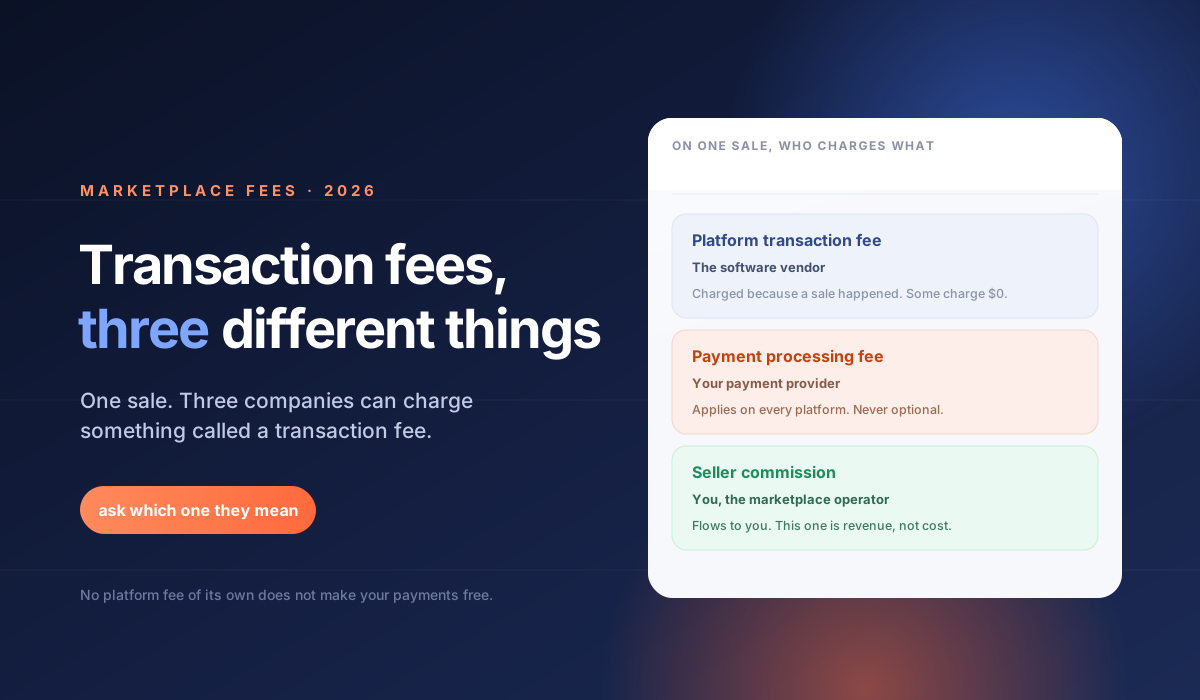
"Transaction fee" is one of the most overloaded phrases in marketplace software. Three different companies can charge something by that name on the same sale, for entirely different reasons, and a quote that mentions one while staying quiet about the others tells you very little. This guide separates them.
Do marketplace platforms charge transaction fees?
Some do, some do not, and the honest answer requires knowing which fee is being discussed. A platform transaction fee is what the marketplace software vendor charges when transactions happen on your marketplace. Whether a given platform charges one, and how it is calculated, is a decision each vendor makes independently — there is no industry standard and no safe assumption.
What you can rely on is that the software vendor's fee is never the only fee. Payment processing is charged by your payment provider on every transaction regardless of which platform you chose, and the commission you charge your own sellers is a third thing entirely, flowing in the opposite direction.
The six fees in a marketplace transaction
Not every marketplace pays all six, but every marketplace should know which of them apply.
| Fee | Charged by | Paid by | Triggered by | Usual shape |
|---|---|---|---|---|
| Subscription / platform access | Software vendor | Marketplace operator | Time — monthly or annual | Fixed, usually tiered |
| Platform transaction fee | Software vendor | Marketplace operator | A transaction on the marketplace | Percentage of sale, or fixed per transaction |
| Payment processing fee | Payment processor | Marketplace operator | A payment being taken | Percentage, often plus a fixed amount |
| Payout / connected-account fee | Payment processor | Depends on the integration | A payout, or an active seller account | Fixed per payout, percentage of payout volume, or per active account |
| Seller / vendor commission | The marketplace operator | The marketplace's sellers | A completed sale | Percentage, sometimes plus a fixed amount |
| Third-party services | SMS, maps, identity, tax vendors | Marketplace operator | Usage | Metered per unit |
Three of those are routinely called a "transaction fee." The software vendor calls its cut one. The payment processor calls its per-payment charge one. Seller-facing marketplaces call the commission they charge sellers one. They are charged by different parties, they are triggered by different events, and in the case of the seller commission the money flows to you rather than from you. Treating them as interchangeable is the single most common error in marketplace fee comparisons.
Platform transaction fee vs payment processing fee
This is the distinction worth getting right, because it is the one vendors most often blur.
The payment processing fee buys a service you cannot do without: money moving from a buyer's card into your marketplace and out to your sellers, along with the compliance and fraud handling that comes with it. You pay it to Stripe, PayPal, Adyen or whoever you have connected, and you pay it whichever marketplace platform you use. Stripe's published Connect pricing is a percentage of each transaction that varies by country, payment method, and where the card was issued, and Connect adds platform-side charges such as per-active-account and per-payout fees depending on how the integration is configured (Stripe publishes region-specific pricing, so check the page for your own market).
The platform transaction fee buys nothing additional. It is the software vendor's revenue, charged because a sale happened on software you are already subscribed to. That is not a criticism of the model — it is how many good platforms make money — but it is why the two behave so differently as you grow. Processing costs scale with money moved because the work scales with money moved. A platform transaction fee scales with money moved while the vendor's costs stay roughly flat.
The practical consequence: a platform advertising no transaction fee of its own has not made your payments free. Those are separate companies, separate invoices, and only one of them is optional.
For how the money actually splits and settles between buyer, seller and platform, see how marketplace payments work.
How platforms actually structure their fees
Four structures cover most of the market. Each of the examples below comes from the vendor's own current pricing page.
Percentage of every sale. The vendor takes a cut of GMV. Common in aggregator and enterprise models, and the structure whose cost grows fastest with your success. Our guide to the app tax on marketplace fees covers the aggregator version of this, where the percentages are much larger.
A transaction allowance, then a charge beyond it. Sharetribe publishes subscription plans that each include a monthly allowance of initiated transactions — 50, 250 and 500 on its live plans — with additional transactions charged at $0.19 or less each, and states that it takes no base commission on sales (verified 29 September 2026, on its published USD pricing). The headline is a subscription, but the effective monthly cost still moves with transaction count.
Conditional on a choice you make. Shopify states that third-party transaction fees may apply when a merchant uses a third-party payment provider instead of Shopify Payments, with the rate depending on the plan (verified 29 September 2026; Shopify publishes region-specific pricing pages, so confirm the rate for your own market). This is worth knowing as a category: a fee that appears only under certain configurations is easy to miss when comparing headline plan prices.
Subscription only, with no platform cut of sales. The vendor charges for access to the software and takes nothing per transaction. Payment processing and third-party services are still billed by those providers.
None of these is inherently better. They distribute cost differently across your growth curve, which is why the comparison has to be done at your expected volume rather than in the abstract.
What fees marketplace sellers pay
Everything above is the operator's view. Your sellers see a different bill, and the terminology flips.
A seller on a marketplace typically pays the commission the operator sets, and on some marketplaces a listing fee or a seller subscription as well. Where sellers are paid out through a connected account, payout timing and any account-level charges may also touch them, depending on how the operator has configured things.
The ambiguity to watch: large seller-facing marketplaces frequently label their own commission a "transaction fee" in seller documentation. From the seller's perspective that is a perfectly reasonable name. But it means a seller and a marketplace operator can use the identical phrase for two completely different charges, paid to two different companies. When you set your own seller-facing terminology, say plainly who is charging what — it prevents a support conversation every week. For how operators set that number, see marketplace business models explained.
How to compare the real fee burden
Use this as a buyer comparison framework, not an accounting standard. Its only job is to make vendors with different fee structures comparable:
Total marketplace fee burden =
    platform subscription
  + platform transaction fee (if any)
  + payment processing
  + payout / account fees (where applicable)
  + third-party services
Different components scale on different drivers, which is why a single headline number is so unreliable:
- Subscriptions may be fixed, or tiered against vendors, orders, storage or seats.
- Platform transaction fees track sales volume or transaction count.
- Payment processing tracks money moved, and varies by country, payment method and card origin.
- Payout and account charges track payout frequency and the number of active seller accounts, not revenue.
- Third-party services track usage — messages sent, maps loaded, identities verified.
So model each component against the driver that actually moves it, at the numbers you expect: transaction volume, GMV, seller and account count, payout pattern, and third-party usage. Then run it again at several times that scale. Two platforms can be a rounding apart at launch and far apart at volume, purely because of which drivers their fees are attached to.
Questions worth asking every vendor in writing: Does any fee apply per transaction, and under what conditions? Is there an included transaction allowance, and what happens past it? Which charges come from you and which from the payment provider? What changes when I double my volume, my seller count, or my payout frequency?
Where Nipige fits
Applying that framework to Nipige: Nipige charges a flat monthly subscription, priced per vertical, and a $0 platform transaction fee on every tier. Nipige does not deduct a platform commission from each sale, and the subscription carries no per-seat or per-user fee. Payment processing is billed separately by the marketplace's payment processor, and metered third-party services such as SMS or maps may carry their own provider charges. Current figures are on the pricing page (verified 29 September 2026).
That places Nipige in the fourth structure above. Whether it works out cheaper for you still depends on your volume and vertical, which is what the framework is for — and the comparison worth running is the whole five-component total, not the subscription line. For the wider cost picture beyond fees, see what marketplace software costs; for the non-price criteria, how to choose marketplace software; and for a fee-model comparison against a specific vendor, the Sharetribe alternative comparison.
Frequently Asked Questions
Do marketplace platforms charge transaction fees?
Some do and some do not. Platform transaction fees are set by each software vendor: some take a percentage of every sale, some charge a fixed amount per transaction above an included monthly allowance, some charge one only under certain conditions, and some charge nothing beyond the subscription. It is a per-vendor question, not an industry standard.
What is a marketplace platform transaction fee?
It is a fee the marketplace software vendor charges when transactions happen on your marketplace, on top of any subscription. It is usually a percentage of the sale or a fixed amount per transaction, and it is paid by the marketplace operator, not by the buyer. It is the vendor's revenue, which is why it grows as your marketplace grows.
Is a platform transaction fee the same as a payment processing fee?
No. They are charged by different companies for different things. The platform transaction fee goes to the software vendor for use of the software. The payment processing fee goes to your payment provider for moving the money, and applies whichever platform you use. A platform charging no transaction fee of its own does not remove the processor's fee.
Can a marketplace platform charge both a subscription and a transaction fee?
Yes, and many do. A subscription buys access to the software, while a transaction fee is charged when sales happen, so the two are independent and often combined. Some vendors include a monthly transaction allowance in the subscription and charge for transactions beyond it, which is a combined model in a different shape.
What does "$0 platform transaction fee" mean?
It means the software vendor takes no cut of sales made through your marketplace. It does not mean payments are free. Your payment processor still charges its own fees on every transaction, and metered third-party services such as SMS, maps, or identity checks are still billed by those providers.
What fees do marketplace sellers pay?
Sellers typically pay whatever commission the marketplace operator sets, and on some marketplaces a listing or subscription fee as well. Confusingly, seller-facing marketplaces often call that commission a transaction fee, even though it is charged by the marketplace operator rather than by the software vendor or the payment processor.
How do I compare transaction fees across marketplace platforms?
Compare five components together at your expected volume: the subscription, the platform transaction fee if any, payment processing, payout and account charges where they apply, and metered third-party services. They scale on different drivers, so a platform that looks cheaper at launch is not necessarily cheaper at the volume you are planning for.
Sources
The Nipige team builds and operates production marketplace infrastructure - vendor onboarding, real-time dispatch, payments, and native apps - drawing on 13+ years of enterprise billing and monetization engineering at Trigital Technologies.